
Agentic AI vs Generative AI
Agentic AI vs Generative AI is one of the most important comparisons for understanding the future of artificial intelligence. Generative AI focuses on creating content such as text, images, code, and videos based on user prompts, while Agentic AI goes beyond content generation by autonomously planning, reasoning, making decisions, and executing multi-step tasks to achieve specific goals. Understanding the differences between Agentic AI and Generative AI helps professionals, students, and businesses choose the right AI approach based on their automation, productivity, and business requirements.
- shaheda Tabassum
Share
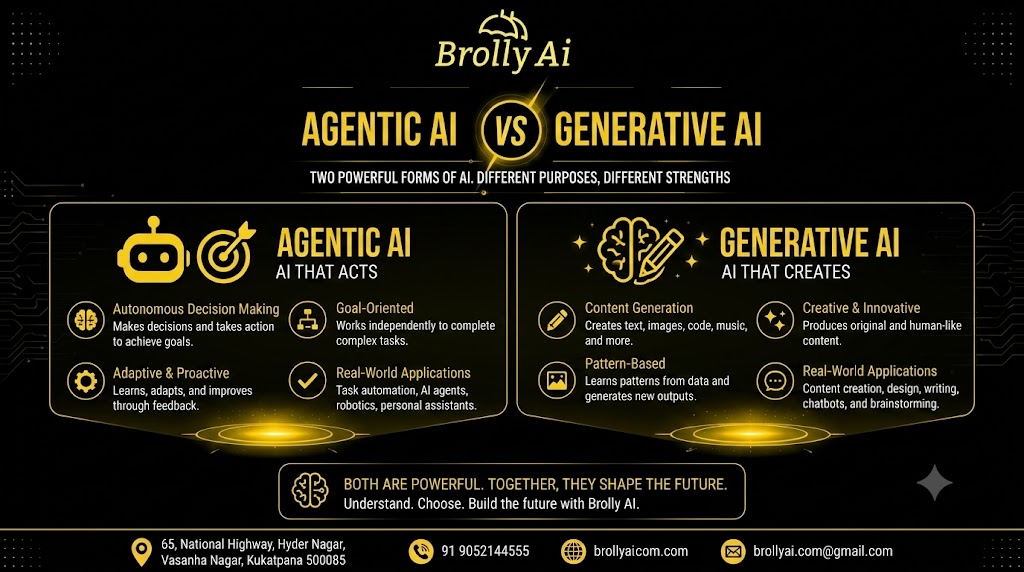
Table of Contents
Agentic AI vs Generative AI (2026): What’s the Real Difference and Which One Should You Use?
Artificial intelligence has evolved so quickly that even experienced professionals struggle to keep up. In 2025–2026, most AI discussions revolved around generative AI—ChatGPT, Gemini, Claude, Midjourney, and every tool that could produce content on demand. But by 2026, a new wave has taken over: agentic AI, or AI systems that don’t just create content… they take action, use tools, plan steps, and complete tasks autonomously.
If generative AI is the writer, designer, or coder that responds to prompts, then agentic AI is the employee who can complete an entire workflow without your supervision. This shift has massive implications for businesses, students, developers, and everyday users.
Companies are already redesigning operations around autonomous agents. Students are learning with AI tutors that manage their study plans. Developers now rely on AI systems that can generate, test, debug, and deploy code with minimal human help. And enterprises are adopting AI agents to cut costs, improve speed, and automate decision-heavy processes.
But the biggest confusion online remains:
“What exactly is the difference between agentic AI and generative AI?”
This guide breaks it down in the clearest way possible. You’ll learn:
- How both technologies work
- Their core differences
- Their features in 2026
- Best use cases for each
- Risks and limitations
- How to decide which one your business or career needs
- 2026 trends shaping the future of AI
Let’s begin with the basics—starting with generative AI.
What Is Generative AI and How Does It Work in 2026?
Generative AI is the type of artificial intelligence designed to generate new content—text, images, code, audio, video, and even 3D simulations. In simple terms, generative AI learns patterns from massive datasets and uses those patterns to create something new on demand.
By 2026, generative AI will have evolved far beyond simple text generation. New models are
- Multimodal (able to process and produce text, images, audio, video, and structured data)
- Real-time (respond instantly with reasoning + generation combined)
- More accurate (reduced hallucinations through better training + agentic validation loops)
- Cheaper to run (due to optimized inference and compressed model architectures)
But at its core, generative AI still works the same way:
You give it a prompt → it predicts the next best output → it generates content.
What Are the Key Characteristics of Generative AI Today?
Generative AI in 2026 has several well-defined traits:
1. Prompt Dependency
It still requires humans to tell it what to generate.
No prompt = no action.
2. Pattern-Based Output
Instead of “thinking,” it recognizes patterns and produces content that statistically fits those patterns.
3. Creativity Without Autonomy
It can write code, draft a legal document, or design a marketing banner—but it cannot execute tasks or act beyond the output unless paired with agentic systems.
4. Single-Step or Single-Turn Operation
A generative model typically completes one action per request, unlike agentic AI, which can execute multi-step plans.
5. High Performance in Creative and Analytical Tasks
From SEO blogs to UX wireframes, it excels where imagination, prediction, or pattern replication is needed.
What Has Changed for Generative AI by 2026?
Generative AI has advanced rapidly. Key improvements include
- Real-time multimodal generation (example: generate + edit video instantly)
- Built-in reasoning (models combine logic and creativity better than in 2023–24)
- Lower hallucination rates due to integrated fact-checking modules
- Domain-specialized models (legal, medical, finance, engineering)
- On-device GenAI for phones, AR glasses, and IoT devices
Generative AI is now more powerful and accessible—but still fundamentally reactive.
Next, we’ll explore what makes agentic AI fundamentally different.
What Is Agentic AI and Why Is It Becoming the 2026 Standard?
Agentic AI represents the next major evolution in artificial intelligence—AI that doesn’t just generate, but actually acts, decides, plans, and executes tasks autonomously. While generative AI waits for users to give a prompt, agentic AI can operate with goals, context, and tools, enabling it to complete multi-step workflows without constant human involvement.
By 2026, agentic AI will have become the backbone of enterprise automation, powering everything from operational workflows to customer service systems, healthcare coordination, and financial analytics. Instead of being limited to content creation, these agents can connect to APIs, interact with applications, run processes, retrieve data, send emails, generate reports, test software, and much more.
In short:
Generative AI creates.
Agentic AI completes.
What Makes Agentic AI Autonomous?
Agentic AI systems exhibit several capabilities that differentiate them from traditional generative models.
1. Goal Persistence
You give the agent a goal—“Optimize this week’s sales report”—and it keeps working until the objective is fulfilled. No repeated prompting required.
2. Multi-Step Planning and Reasoning
Agents break tasks into smaller actions, perform them sequentially, and adjust their plan as they progress.
3. Tool and API Integration
Agentic AI can interact with:
- CRMs
- Browsers
- Databases
- Email systems
- Cloud services
- DevOps tools
- Internal applications
This unlocks end-to-end workflow automation.
4. Environment Awareness
Agents analyze the state of systems, interpret changes, and make decisions in real time.
5. Memory and Feedback Loops
Agents learn from previous tasks, maintain context, store information, and refine future actions.
How Do AI Agents Actually Work? (Simple Workflow)
Most agentic AI systems follow a loop known as SPAE:
- Sense – Gather data from tools, environments, and user inputs.
- Plan – Break down the task into steps and set priorities.
- Act – Execute actions using tools, APIs, or other agents.
- Evaluate – Assess outcomes and adjust the plan if needed.
This cycle repeats until the agent completes the assigned goal, making it behave more like a digital coworker than a content generator.
What Are the Key Differences Between Agentic AI and Generative AI in 2026?
Although both technologies rely on large language models, their purpose, behavior, and capabilities are fundamentally different. Understanding these differences is essential for choosing the right AI strategy in 2026—especially as businesses shift from simple content generation to full workflow automation.
Below is a clear breakdown of how they differ.
How Do Their Core Purposes Differ?
Generative AI
- Designed to produce new content
- Works best for creation, summarization, rewriting, and analysis
- Delivers value through creativity and pattern recognition
Agentic AI
- Designed to achieve goals
- Works best for automation, execution, and decision-making
- Delivers value through action, autonomy, and workflow completion
In short
GenAI = “Create something for me.”
Agentic AI = “Do something for me.”
How Does Autonomy Differ?
Generative AI
- Requires human prompts
- Produces output once and stops
- Cannot act beyond generating text or media
Agentic AI
- Operates with minimal supervision
- Performs multi-step tasks until finished
- Can initiate actions based on triggers, goals, or environment changes
Example
- GenAI can write an email.
- Agentic AI can write, send, track replies, categorize responses, and schedule meetings.
How Do They Handle Context and Adaptation?
Generative AI
- Holds context only within a session’s window
- Cannot remember past tasks unless manually fed back
- Limited adaptability
Agentic AI
- Uses persistent memory
- Learns from prior actions
- Adjusts strategies when conditions change
- Can collaborate with other agents or external tools
Full Comparison Table — Agentic AI vs Generative AI (2026)
Brolly AI keeps its pricing transparent and easy to compare. Instead of a single confusing figure with hidden add-ons, you get three straightforward training modes, each priced for what it delivers.
| Factor | Generative AI | Agentic AI |
|---|---|---|
| Primary Purpose | Content creation | Task completion & automation |
| Autonomy | Low | High |
| Workflow Style | Single-turn | Multi-step, goal-driven |
| Tool Use | None or limited | Full API & system integrations |
| Adaptability | Limited | Strong contextual learning |
| Memory | Short-term | Long-term & persistent |
| Output Type | Responses | Actions + outcomes |
| Best For | Creativity, writing, analysis | Operations, automation, decision-heavy tasks |
| Human Role | Continuous prompting | Occasional guidance |
| Risk Level | Lower | Higher (due to autonomy) |
Agentic AI is not a replacement for generative AI—they serve different roles. But in 2026, the shift is clear: businesses depend increasingly on agentic systems to automate processes previously handled by humans, while generative AI continues powering content, design, and analysis tasks.
What Are the Most Important Features of Generative AI in 2026?
Even as Agentic AI continues to evolve, Generative AI remains an essential technology. In 2026, it serves as the foundation for creativity, communication, and rapid idea generation across almost every industry.
Modern Generative AI models are more accurate, context-aware, and capable than ever before, making them valuable tools for students, marketers, developers, business professionals, and enterprise teams.
Below are some of the most important features of Generative AI in 2026.
1. Content Creation and SEO Optimization
Generative AI has become the driving force behind modern content marketing and SEO strategies. It helps businesses create high-quality, search-engine-friendly content quickly and efficiently.
Key benefits include:
Creating SEO-optimized blog articles at scale
Updating and rewriting outdated content
Generating keyword variations and meta descriptions
Understanding search intent for better content optimization
Creating social media posts, emails, advertisements, and video scripts
2. Image and Video Generation
Generative AI enables users to create high-quality images, videos, illustrations, and marketing creatives from simple text prompts. Businesses use it for advertisements, product visuals, presentations, and social media content, saving both time and production costs.
Key benefits include:
Creating AI-generated images and graphics
Producing promotional and explainer videos
Designing marketing materials instantly
Generating visual content for websites and social media
Reducing creative production time.
3. Code Generation and Software Development
Generative AI helps developers write, debug, optimize, and document code more efficiently. It accelerates software development while improving productivity and reducing errors.
Key benefits include:
Generating code in multiple programming languages
Debugging and fixing coding errors
Writing technical documentation
Explaining complex code snippets
Speeding up software development
4. Business Automation and Productivity
Organizations use Generative AI to automate repetitive tasks and improve workplace productivity. It assists employees with drafting content, summarizing information, and generating reports, allowing teams to focus on higher-value work.
Key benefits include:
Summarizing documents and meetings
Creating reports and presentations
Drafting emails and business proposals
Automating routine office tasks
Improving employee productivity
5. Personalized Learning and Customer Support
Generative AI delivers personalized learning experiences and enhances customer service through intelligent conversations and instant assistance. It adapts responses based on user needs, improving engagement and satisfaction.
Key benefits include:
Providing personalized learning recommendations
Offering 24/7 AI-powered customer support
Answering frequently asked questions instantly
Creating customized study materials
Improving customer engagement and user experience
How Does It Help With Marketing and Product Design?
Generative AI enhances the entire creative cycle
- Generates brand visuals and product mockups
- Creates storyboard drafts for ads
- Design user journey flows
- Rapidly produces UI/UX concepts
- Helps marketers test variations instantly
With multimodal generation, teams can move from idea → prototype in hours instead of weeks.
2026 change
GenAI tools now integrate with 3D engines, enabling realistic product simulations for e-commerce and engineering.
How Does Generative AI Support Customer Support in 2026?
While agentic AI powers full automation, generative AI still runs:
- Chat responses
- Knowledge-base summaries
- FAQ drafting
- Sentiment analysis
- Ticket classification
- Email reply suggestions
Customer support teams combine GenAI with agentic systems:
GenAI writes → Agentic AI executes.
Example
GenAI drafts a refund email.
An agentic system processes the refund in the backend.
Generative AI is now smarter and more versatile than ever—but it still cannot complete tasks independently. That’s where agentic AI shines.
How Does Agentic AI Automate Business Workflows?
Agentic AI can execute entire processes end-to-end, turning multi-step tasks into hands-off, automated workflows. Examples include:
- Processing customer orders
- Updating CRM records
- Pulling analytics from multiple systems
- Generating, sending, and tracking emails
- Running competitor research
- Coordinating project management tasks
- Managing HR onboarding sequences
Unlike generative AI, which creates outputs, agentic AI acts to finish the job.
Example
Instead of just writing a report, the agent can:
- Gather data → 2) Generate the report → 3) Format it → 4) Upload it → 5) Send it to the right team.
What Makes Agents Ideal for Enterprise Operations?
Enterprises in 2026 rely heavily on agentic AI because it is:
Scalable
Agents can manage thousands of tasks simultaneously across departments.
Consistent
No performance fluctuations, fatigue, or mistakes caused by human error.
Cost-efficient
Reduces operational workload, headcount requirements, and manual labor.
Always on
Agents operate 24/7 with real-time monitoring.
Integratable
They connect with enterprise stacks such as
- ERP systems
- Salesforce
- HubSpot
- Jira
- ServiceNow
- SAP
- Financial tools
- Custom APIs
This makes them an ideal solution for digital transformation.
How Do Agents Use External Tools and APIs?
This is the core capability that generative AI lacks.
Agentic AI can
- Access web browsers
- Query databases
- Make API calls
- Modify spreadsheets
- Run code
- Interact with cloud services
- Trigger workflows in apps like Zapier, Slack, and Notion
- Perform real-time monitoring
- Validate information before acting
By integrating with software tools, agents become powerful digital workers capable of handling any process that a human employee could do on a computer.
Agentic AI is not just an upgrade—it’s a shift in what AI can do.
Next, let’s explore their strongest use cases.
What Are the Best Use Cases for Generative AI in 2026?
Even as businesses adopt agentic systems for automation, generative AI remains essential for creativity, communication, and rapid idea development. In 2026, organizations rely on GenAI not for “doing the work,” but for shaping the thinking, designing the content, and accelerating innovation.
Below are the highest-value, high-demand use cases dominating 2026.
Content Creation & SEO
Generative AI drives 70–80% of content ideation and drafting across industries in 2026. It helps teams
- Generate SEO-ready articles
- Build topic clusters and silos
- Create outlines, headlines, and meta tags
- Rewrite and update old content
- Generate social media posts and captions
- Produce scripts for podcasts, YouTube, and webinars
- Create multilingual versions of content in seconds
Because search engines increasingly reward depth + accuracy, GenAI is used to quickly draft, while humans refine—making content faster and more trustworthy.
Code Generation & Prototyping
Developers now use GenAI as a supercharged assistant for:
- Writing code
- Suggesting better algorithms
- Fixing bugs
- Refactoring old systems
- Creating test cases
- Converting legacy code to modern languages
- Generating full prototypes or UI layouts
In 2026, many engineering teams pair GenAI with agentic systems:
- GenAI writes code
- Agents test, deploy, monitor, and fix issues automatically
This combination drastically reduces development cycles.
Customer Support Augmentation
Generative AI is still the backbone of customer communication. It helps teams:
- Draft human-like ticket responses
- Summarize conversations
- Identify intent and sentiment
- Recommend solutions to agents
- Answer FAQs
- Classify and route tickets
- Generate email replies
While agentic AI handles workflow execution (refunds, account updates, scheduling, verification), generative AI provides the language layer that ensures clear, accurate interactions.
In simple terms:
GenAI handles the “conversation.”
Agentic AI handles the “action.”
Generative AI powers creativity, engineering, and communication—but agentic AI takes those outputs and turns them into completed tasks.
What Are the Best Use Cases for Agentic AI in 2026?
Agentic AI is the engine behind the 2026 automation revolution. While generative AI creates content and ideas, agentic AI takes action—connecting tools, executing workflows, gathering data, and completing multi-step tasks that once required human involvement.
Here are the most valuable and widely adopted agentic AI use cases in 2026.
Customer Service Automation
Enterprise adoption exploded from 2024 to 2026 because agentic AI can handle entire customer support workflows, not just chats.
Agentic systems can
- Read and understand support tickets
- Retrieve customer records
- Process refunds or exchanges
- Update backend systems
- Draft and send follow-up emails
- Escalate cases when needed
- Monitor satisfaction metrics
- Close or reopen tickets automatically
This reduces workload for customer service teams by up to 60–70%.
Example
A customer requests a refund → the agent checks eligibility → processes refund → updates CRM → emails confirmation → logs all details.
Workflow Management & IT Automation
Agentic AI is a game-changer for IT teams and operations departments.
Agents can now
- Manage cloud deployments
- Monitor servers and systems
- Debug simple issues
- Trigger alerts and notifications
- Coordinate project tasks
- Auto-update documentation
- Run CI/CD pipelines
- Manage routine security tasks
These AI agents function like 24/7 junior engineers who never stop working.
Healthcare & Financial Operations
These industries are early adopters in 2026 due to large volumes of repetitive, rule-driven tasks.
In Healthcare
Agents assist with
- Patient onboarding
- Appointment scheduling
- Insurance verification
- Report summarization
- Care pathway coordination
In Finance
Agents support
- Fraud detection workflows
- Risk scoring
- Portfolio rebalancing
- Transaction monitoring
- Regulatory documentation
Because these tasks involve structured rules, agentic systems excel.
Autonomous Software Testing & DevOps
Agentic AI is rapidly transforming engineering teams by taking over routine development tasks.
Agents can
- Generate test cases
- Run automated tests
- Debug failures
- Document issues
- Suggest fixes
- Deploy code
- Perform post-deployment audits
Combined with generative AI (for coding), agentic AI turns software development into a largely automated pipeline.
Agentic AI is the backbone of automation in 2026—reducing costs, improving speed, and enabling round-the-clock execution without human supervision.
What are the Core Risks and Limitations you Should know ?
Even though generative AI and agentic AI are powerful, neither is perfect. By 2026, businesses, educators, and developers will understand that AI adoption isn’t just about capability—it’s about managing risk, ensuring reliability, and protecting users.
Here are the most important limitations and concerns you should be aware of.
1. Hallucination & Inaccuracy Still Exist
Even in 2026, generative models can produce text that sounds correct but is factually wrong, outdated, or misinformed.
2. Lack of Verification
GenAI generates based on probabilities—not truth—making validation essential for legal, academic, and technical content.
3. Limited Context Windows
Although larger than before, generative models still can’t remember everything across sessions unless paired with memory tools.
4. Prompt Dependence
Without a clear prompt, GenAI doesn’t know what to do.
It waits for instructions and cannot act independently.
5. No Real-World Action Ability
It can write, suggest, analyze, and create, but it cannot:
- Send emails
- Update a database
- Run tests
- Modify a CRM
- Execute workflows
This is the biggest difference between GenAI and agentic systems.
What Risks Are Unique to Agentic AI?
Agentic AI is more powerful—but that also makes it riskier.
1. Over-Autonomy
If not carefully controlled, agents can take actions too broadly or too aggressively (e.g., sending too many emails, updating wrong records).
2. Error Propagation
A single wrong decision can spread across multiple tools because agents perform chains of actions.
Given their autonomy, small mistakes scale quickly.
3. Goal Misalignment
If the agent interprets a goal incorrectly, it might optimize for the wrong outcome.
4. Security Vulnerabilities
Agents with tool access must be heavily protected to prevent:
- Unauthorized API calls
- Data breaches
- System manipulation
- Unintended financial actions
5. Accountability Challenges
When an autonomous agent makes a bad decision, who is responsible—the user, the developer, or the organization?
This question becomes increasingly important in regulated industries.
Both generative and agentic AI provide enormous value, but responsible use requires understanding their limitations and designing systems that minimize risk.
When Should You Use Generative AI vs Agentic AI in 2026?
Choosing between generative AI and agentic AI in 2026 isn’t about which one is “better.” It’s about understanding which one fits the task, the workflow, and the level of autonomy you need.
This section gives you a clear decision-making framework, so you always pick the right tool.
When Is Generative AI the Better Choice?
Use generative AI when your primary need is creation, ideation, or analysis.
Use GenAI if
- You need written content (blogs, emails, scripts, textbooks)
- You’re brainstorming ideas, titles, or marketing angles
- You want to summarize documents or extract insights
- You need code generation or debugging suggestions
- You need creative outputs like images, logos, audio, or videos
- You require fast experimentation or prototyping
- You want human-reviewed content, not automated execution
Examples
- Writing a research summary
- Drafting product descriptions
- Creating UI design concepts
- Generating social media templates
- Producing email copy or newsletters
In short
GenAI is your “creative assistant”—not your workflow executor.
When Should You Choose Agentic AI?
Use agentic AI when you need automation, action, or multi-step task completion.
Use Agentic AI if
- You want a system to complete tasks without manual input
- You need workflows executed end-to-end
- You want tools or APIs integrated with AI
- You need 24/7 autonomous operation
- You want real-time decision-making
- You need complex orchestration across apps
Examples
- Processing refunds in customer service
- Updating CRM records automatically
- Running a weekly competitor analysis
- Managing financial transaction monitoring
- Executing DevOps deployments and tests
- Coordinating healthcare scheduling and verification
In short
Agentic AI is your “digital employee”—the system that gets things done.
Should You Use Both? (Hybrid Setup)
In 2026, the most successful organizations do not choose one—they use both together.
Hybrid Workflow Example
- GenAI generates the marketing email, product description, or report.
- Agentic AI sends it, schedules follow-ups, updates the CRM, and tracks performance.
Why Hybrid is Best
- GenAI handles creativity
- Agentic AI handles execution
- Humans handle supervision and improvement
This combined approach reduces operational friction and increases speed across projects.
What Are the Biggest 2026 Trends for Agentic AI and Generative AI?
AI has evolved faster than any other technology in history, and 2026 marks a major shift—from AI that creates to AI that acts. Understanding these trends helps businesses, educators, and professionals prepare for the next wave of innovation.
Here are the most impactful trends shaping agentic and generative AI in 2026.
What GenAI Innovations Are Emerging in 2026?
Generative AI continues to improve, but the focus has shifted from novelty to specialization, accuracy, and multimodality.
1. Real-Time Multimodal Assistants
AI systems now handle live conversations, combining text, voice, and visuals simultaneously.
2. Domain-Specialized Models
Instead of one-size-fits-all LLMs, 2026 brings specialized GenAI models for:
- Law
- Healthcare
- Engineering
- Finance
- Cybersecurity
- Education
These models offer higher accuracy and fewer hallucinations.
3. AI-Generated Simulations & Digital Twins
GenAI powers product simulation, training environments, and predictive modeling through 3D and physics-based generation.
4. On-Device GenAI
Phones, cars, VR headsets, and IoT devices now run GenAI locally, making privacy and speed significantly better.
What Agentic AI Advancements Are Dominating in 2026?
Agentic AI is the fastest-growing category because it empowers organizations to automate operations at scale.
1. Multi-Agent Systems Become Standard
Enterprises use swarms of agents working together like digital teams:
- Research agent
- Operations agent
- Finance agent
- Customer support agent
- Engineering/test agent
This dramatically improves throughput.
2. Agentic AI OS (Operating Systems)
Companies now deploy “AI operating layers” that coordinate all agents across departments, similar to managing employees.
3. Cross-Application Autonomy
Agents move seamlessly across tools and apps:
- Browser → CRM → Analytics dashboard → Email → Internal system
This replaces hundreds of manual steps.
4. Safety Alignment Layers
New safety mechanisms prevent autonomous agents from taking harmful or unintended actions
- Guardrails
- Policy frameworks
- Real-time human override systems
5. Industry-Integrated Agents
Sectors like healthcare, finance, education, legal, and logistics now deploy customized agentic AI systems trained on industry-specific workflows.
Together, these trends show the direction AI is heading:
Generative AI for thinking. Agentic AI for doing. Human-AI teams for winning.
How Can Students and Professionals Learn These Technologies in 2026?
As generative and agentic AI reshape industries, the most valuable skill in 2026 is knowing how to work with AI, not just how to use it. Whether you’re a student, job seeker, employee, or entrepreneur, learning these technologies gives you a major advantage.
Here’s what you need to focus on to stay competitive.
What Skills Do You Need First?
You don’t need to be a programmer to start. But you do need foundational AI fluency.
AI and Prompting Fundamentals
Learn how to
- Write effective prompts
- Use system instructions
- Structure complex queries
- Guide AI to reason, not just respond
Prompting is still a major skill—but in 2026, it’s evolving into instruction design and agent orchestration.
2. Understanding Agent Workflows
Even non-technical users should know:
- How agents plan
- How they use tools
- How triggers and goals work
- How to design safe task boundaries
This knowledge helps you supervise AI agents effectively.
3. Basic Technical Literacy
You don’t need advanced coding, but understanding these basics helps:
- APIs
- Automation workflows
- Data formats
- Spreadsheets
- Cloud tools
This makes you AI-ready for most jobs.
4. Domain Knowledge
AI is most powerful when paired with expertise.
Marketing + AI, Finance + AI, Healthcare + AI, Engineering + AI = super skills.
What Are the Most Popular Tools for Beginners?
Here are the most widely used tools for learning and experimenting with AI agents and GenAI in 2026.
| Tool | Type | Best FOR | Difficulty |
|---|---|---|---|
| OpenAI o1 Agents | Agentic AI | Business workflows, automation | Easy |
| LangChain | Agent framework | Custom agent development | Medium |
| CrewAI | Multi-agent systems | Teams of agents | Medium |
| AutoGen | Conversational agents | Research + collaboration | Medium |
| Hugging Face | GenAI models | Model training + fine-tuning | Medium |
| Replit AI | GenAI coding | Learning to build apps | Easy |
| Zapier AI Actions | No-code automation | Connecting apps with agents | Very Easy |
This combination helps you learn both creative AI (GenAI) and action-oriented AI (Agentic) without overwhelming complexity.
Learning AI in 2026 is less about memorizing skills and more about learning how to collaborate with autonomous systems. The future belongs to those who know how to guide, supervise, and build with AI—no matter their background.
What’s the Final Verdict for 2026 — Which AI Wins?
By 2026, it’s clear that the question isn’t “Which AI is better?” but rather “Which AI is best for the task at hand?” Generative AI and agentic AI are not competitors—they’re complementary technologies designed for different purposes.
Generative AI excels at
- Content creation
- Communication
- Creativity
- Idea generation
- Rapid prototyping
- Writing and analysis
- Code generation
Agentic AI excels at
- Completing tasks
- Running workflows
- Connecting tools and systems
- Automating operations
- Handling multi-step processes
- Real-world decision making
- Executing business logic
Think of them as two parts of the same intelligence system:
- Generative AI is the brain → It thinks, imagines, and produces ideas.
- Agentic AI is the body → It acts, executes, interacts, and gets things done.
Together, they create a powerful hybrid model where:
- Humans provide goals
- Generative AI creates strategy and content
- Agentic AI executes the plan
- Humans approve outcomes and optimize the loop
This human + generative AI + agentic AI collaboration is becoming the new productivity standard in 2026 for businesses, students, educators, and developers.
Which One Should You Use?
Use Generative AI if your goal is:
- Creating content
- Exploring ideas
- Learning concepts
- Improving writing or communication
- Rapidly iterating on designs or prototypes
Use Agentic AI if your goal is
- Automating repetitive work
- Solving operational bottlenecks
- Increasing business efficiency
- Reducing manual labor
- Handling multi-step tasks at scale
Use both if your goal is
- Building future-ready workflows
- Enhancing team productivity
- Creating autonomous business systems
- Scaling processes with minimal oversight
And because both technologies are evolving together, the smartest strategy is to adopt a hybrid AI approach that multiplies human capability instead of replacing it.
Frequently Asked Questions
1.What is the main difference between agentic AI and Generative AI?
Generative AI creates content. Agentic AI completes tasks. GenAI relies on prompts, while agentic AI uses goals, tools, and actions.
2. Is agentic AI built on top of generative AI models?
Yes. Most agentic systems use generative AI as the reasoning engine, then add autonomy, planning, and tool-use layers.
3. Why is agentic AI becoming popular in 2026?
Businesses want automation, not just content. Agentic AI reduces manual work, integrates with tools, and performs complete workflows.
4. Can generative AI perform multi-step tasks?
Not independently. It can describe steps, but cannot execute them without an agentic layer.
5. Is agentic AI safe to use in business environments?
Yes, if guardrails, permissions, audit logs, and human oversight are implemented.
6. Does agentic AI replace generative AI?
No. They’re complementary. Generative AI creates ideas; agentic AI executes actions.
7. What industries benefit most from agentic AI?
Customer service, finance, healthcare, logistics, eCommerce, and IT operations—all heavily process-driven workflows.
8. What industries rely more on generative AI?
Marketing, education, design, content creation, software development, and research.
9. Can agentic AI make decisions without humans?
Yes, within set policies, rules, and boundaries. Humans still define goals and approve sensitive actions.
10. Does generative AI still hallucinate in 2026?
Yes, but less frequently. Safety models and retrieval layers reduce errors, but verification is still required.
11. Are agentic AI systems more expensive to run?
Typically, yes, because they use
- More compute
- More integrations
- Continuous monitoring
- Multi-step actions
But they often save money by reducing manual labor.
12. Can small businesses use agentic AI?
Absolutely. In 2026, AI tools will have become more plug-and-play, making advanced automation accessible without coding.
13. How do AI agents use external tools?
Through APIs, browser actions, database calls, cloud functions, or integrations with apps like Slack, Notion, and CRMs.
14. What skills do beginners need to work with agentic AI?
Basic prompting, workflow design, and understanding triggers/actions. Coding is optional but helpful.
15. Can agentic AI work with multiple agents at once?
Yes. Multi-agent systems are a major 2026 trend—teams of specialized agents collaborating like digital coworkers.
16. Is generative AI enough for business automation?
No. Generative AI can describe or recommend, but only agentic AI can do and complete tasks.
17. Are AI agents risky?
They can be if not properly restricted. Risks include error propagation, over-autonomy, and unintended actions.
18. What are examples of agentic AI tasks?
Processing refunds, updating CRMs, onboarding employees, running DevOps pipelines, or generating and sending weekly reports.
19. Should freelancers and students learn agentic AI?
Yes. Knowing how to guide and manage agents will be a top skill for 2026–2030 job markets.
20. Will agentic AI and generative AI eventually merge?
Yes. The industry is moving toward unified systems where one AI can think (GenAI) and act (Agentic AI) seamlessly.