
Types of AI Systems: What Are They and How Do They Work in 2026?
Why Is Everyone Searching for “Types of AI Systems” Today?
Artificial Intelligence is no longer a futuristic idea.
In India, AI has quietly become part of daily life.
You see it when
- Your phone unlocks using face recognition
- Banks detect suspicious UPI transactions.
- OTT platforms recommend shows and movies
- Chatbots answer queries on government and college websites.
All of these are AI systems working behind the scenes.
However, when learners search for “Types of AI Systems”, they often feel confused instead of informed.
The internet is full of
- Complex definitions
- Outdated explanations
- Heavy technical language
- Science-fiction exaggerations
That confusion is exactly why this topic is trending in 2026, especially among Indian learners who want clarity, not hype.
What This Guide Will Help You Understand
By the end of this guide, you will be able to clearly explain:
- How AI systems are classified and categorized
- The real difference between ANI, AGI, and ASI
- How AI systems function internally (memory, learning, behavior)
- Modern AI categories shaping 2026 and beyond
- Which AI systems actually matter for careers in India
This guide is written like a mentor explaining AI, not like a research paper.
Who Is This Guide For and What Is the Search Intent?
Are Students, Professionals, or Non-Tech Learners Looking for This Topic?
The keyword “Types of AI Systems” has a strong informational and educational intent.
It attracts three major groups of learners, each with different expectations.
Students and Beginners
This includes
- Engineering students (CSE, IT, AI, & DS)
- BCA, MCA, and diploma students
- School students studying AI fundamentals
- Learners preparing for competitive exams and interviews
What students are really searching for:
- Easy definitions they can remember
- Clear classification without confusion
- Examples they can relate to daily life
- Tables and comparisons for quick revision
The problem they face:
Most blogs explain AI in a technical or academic tone, not in a teaching tone.
Professionals and Career Switchers
This group includes
- Working IT professionals
- Data analysts and developers
- Product managers and consultants
- MBA graduates entering tech roles
What they are looking for
- Practical AI categories used in real products
- Understanding beyond textbook definitions
- Skills and career relevance
- Awareness of future-proof AI systems
The gap they notice:
Many articles stop at ANI vs AGI and ignore modern AI systems actually used in 2026.
Non-Technical Learners
This group includes:
- Educators and trainers
- Business owners and founders
- Policymakers and administrators
- Curious learners with no coding background
What they want:
- Conceptual clarity
- Ethical and societal impact
- AI explained in simple language.
- Regulatory and governance context
Why Do We Need to Classify AI Systems at All?
What Problems Does AI Classification Actually Solve?
Many beginners ask a simple question:
“Why can’t we just call everything AI?”
The answer is — because not all AI systems are the same.
Without proper classification
- AI looks mysterious and confusing
- Expectations become unrealistic
- Learners mix up science fiction with real technology.
- Businesses and governments misuse AI.
AI classification brings structure, clarity, and realism.
1. It Helps Us Understand What AI Can and Cannot Do
Not every AI system can:
- Think like a human
- Learn everything on its own
- Make ethical decisions
- Understand emotions
When we classify AI systems, we clearly see:
- Which AI is task-based
- Which AI can learn from data
- Which AI is purely theoretical
This prevents common myths like:
- “AI has consciousness.”
- “Chatbots understand emotions.”
- “AI will replace all jobs soon.”
2. It Separates Reality from Hype and Science Fiction
Movies and media often show AI as:
- Fully intelligent
- Emotionally aware
- Dangerous or all-powerful
In reality, most AI systems in 2026 are narrow and limited.
Classification helps learners:
- Identify real-world AI
- Ignore exaggerated claims
- Build practical expectations
This is especially important for students and non-technical learners.
3. It Makes Learning AI Easier and More Structured
AI is a broad field that includes:
- Machine learning
- Deep learning
- Natural language processing
- Computer vision
- Robotics
Classification acts like a learning roadmap.
Instead of feeling overwhelmed, learners can:
- Start with AI basics
- Understand types step by step.
- Connect concepts logically
This is why AI is taught using classifications in schools and universities.
4. It Helps You Choose the Right Skills to Learn
Different AI systems require different skills.
For example
- Limited Memory AI → Machine learning, data science
- Agentic AI → Workflow automation, tool integration
- High-risk AI → Ethics, governance, compliance
When you understand AI types, you avoid:
- Learning unnecessary tools
- Chasing hype-based skills
- Wasting time on irrelevant courses
This matters a lot for career planning in India.
5. It Supports Responsible and Ethical AI Use
Some AI systems are low-risk.
Others directly affect human lives.
Examples
- Recommendation systems → Low risk
- Credit approval systems → Medium risk
- Biometric surveillance → High risk
Classification allows
- Governments to regulate AI properly
- Companies to apply safeguards
- Society demands transparency.
This is why modern AI laws focus on AI categories, not just “AI”.
6️. It Is Important for Exams, Interviews, and Policy Discussions
In India, AI classification is now part of:
- School AI curricula
- Engineering syllabi
- Government AI frameworks
- Interview questions
Students are often asked:
- “Explain types of AI systems.”
- “Differentiate ANI and AGI”
- “What are modern AI categories?”
Without a clear classification, answering these becomes difficult.
Key Takeaway from This Section
AI classification is not theory for theory’s sake.
It is a practical tool to understand, learn, regulate, and apply AI correctly.
Once you understand classification, everything else in AI becomes easier.

Types of AI Systems by Capability
What Can an AI System Actually Do?
When people ask about types of AI systems, this is usually the first and most important classification they encounter.
AI systems are often grouped based on their capability, meaning:
How intelligent is the system, and how broadly can it apply its knowledge?
This classification answers a ubiquitous question:
“How smart is this AI, really?”
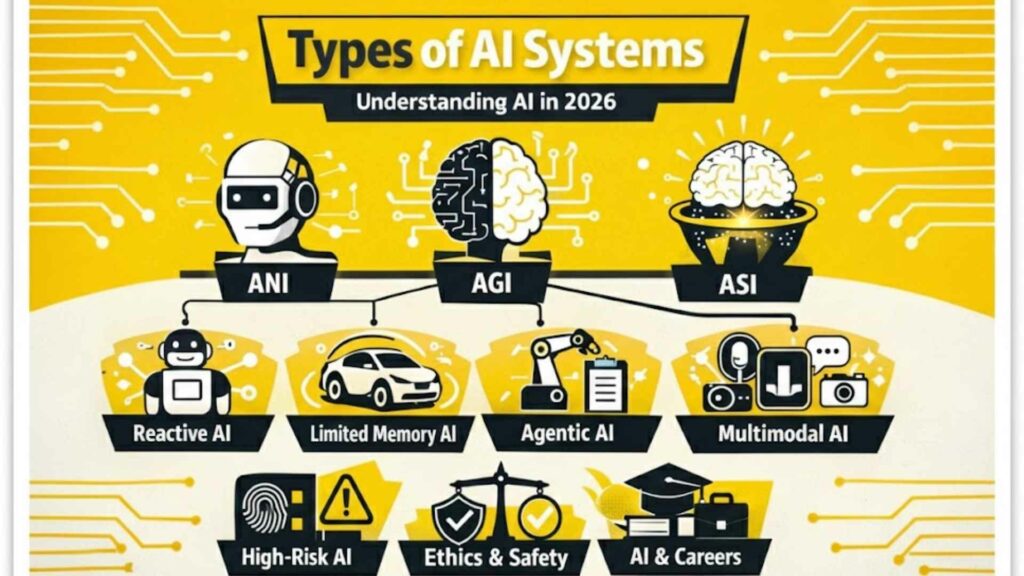
There are three main types of AI systems by capability:
- Artificial Narrow Intelligence (ANI)
- Artificial General Intelligence (AGI)
- Artificial Superintelligence (ASI)
Let’s understand them one by one, without hype.
What Is Artificial Narrow Intelligence (ANI)?
Why Is ANI Called “Weak AI” Even Though It Feels Smart?
Artificial Narrow Intelligence (ANI) is an AI system designed to perform one specific task or a minimal set of tasks.
It may look intelligent.
It may even outperform humans in that task.
But it cannot go beyond what it is trained to do.
That is why ANI is often called “Weak AI” — not because it is useless, but because it is narrow in scope.
Key Characteristics of ANI
Artificial Narrow Intelligence systems:
- Focus on a single task
- Do not understand context beyond training.
- Cannot transfer learning to new domains
- Operate within predefined boundaries.
Even the most advanced AI tools in 2026 still fall under this category.
Everyday Examples of ANI You Already Use
You interact with ANI systems daily, often without noticing:
- Facial recognition on smartphones
- Email spam filters
- YouTube and OTT recommendations
- Voice assistants like Siri and Alexa
- Recommendation engines used by Netflix
Each of these systems does one job very well — and nothing more.
How ANI Is Used in India (Real-World Context)
In India, ANI systems power many critical services:
- Banking & Fintech
- Fraud detection in UPI and credit cards
- Loan eligibility scoring
- Education & EdTech
- Automated exam evaluation
- Personalized learning recommendations
- Healthcare
- Medical image analysis
- Appointment scheduling chatbots
- Government & Public Services
- Face recognition for identity verification
- Citizen support chatbots
Despite their impact, all of these systems are still task-specific AI.
A Common Misconception About ANI
Many people believe:
“Chatbots and AI tools can think like humans.”
In reality
- ANI systems do not think
- They do not understand the meaning.
- They do not have awareness.
They identify patterns in data and respond accordingly.
Why ANI Dominates AI in 2026
ANI dominates because:
- It is practical
- It is scalable
- It is safer than general AI.
- It solves real business problems.
For students and professionals, ANI is the most important AI type to understand and learn today.
What Is Artificial General Intelligence (AGI)?
Can an AI System Really Think Like a Human?
Artificial General Intelligence (AGI) refers to AI systems that would have human-level intelligence.
An AGI system would be able to
- Learn any subject like a human
- Apply knowledge across domains.
- Reason, plan, and adapt independently
- Solve unfamiliar problems without retraining.
In simple terms
AGI would not be trained for one task — it would learn anything.
Does AGI Exist in 2026?
The short answer is: No.
As of 2026:
- No AI system has human-level general intelligence
- No AI system understands the world the way humans do
- AGI remains a research goal, not a reality
Even the most advanced AI models today are still ANI, not AGI.
Why Is AGI So Difficult to Build?
Human intelligence involves
- Common sense reasoning
- Emotional understanding
- Social awareness
- Learning from very little data
Current AI systems:
- Need massive datasets
- Lacks real-world understanding
- Cannot reason independently
This gap is why AGI remains theoretical.
Why AGI Still Matters
Even though AGI does not exist yet, it matters because:
- It guides long-term AI research
- It raises ethical and safety discussions.
- It influences future education and policy planning.
Understanding AGI helps learners separate future possibilities from present reality.
What Is Artificial Superintelligence (ASI)?
Will AI Ever Become Smarter Than Humans?
Artificial Superintelligence (ASI) refers to a hypothetical AI system that would surpass humans in every aspect of intelligence.
This includes
- Logical reasoning
- Creativity
- Emotional intelligence
- Scientific discovery
- Social decision-making
ASI would not just match humans — it would outperform them in all domains.
Does ASI Exist Today?
No.
There is
- No working ASI
- No prototype
- No confirmed pathway to build it
ASI exists only in
- Theoretical discussions
- Long-term AI safety research
- Science fiction narratives
Why Do People Talk About ASI Then?
ASI is discussed because
- It raises important safety questions
- It helps plan long-term AI governance.
- It encourages ethical thinking before technology advances.
For learners, ASI is useful to understand limits and responsibilities, not current skills.
How Do ANI, AGI, and ASI Compare?
Capability-Based Comparison Table
AI Type | Scope of Intelligence | Learns Across Domains | Exists in 2026? | Real-World Use |
Task-specific | No | Yes | Everywhere | |
AGI | Human-level | Yes | No | Research only |
ASI | Beyond human | Yes | No | Hypothetical |
Key Takeaway from Capability-Based AI
All real-world AI systems today are Artificial Narrow Intelligence.
Understanding this single fact removes most confusion about AI.
Types of AI Systems by Functionality
How Do AI Systems Work Internally?
After understanding what an AI system can do (capability), the next important question is:
How does an AI system actually work inside?
This classification focuses on:
- Whether AI has memory
- Whether it can learn from past data
- How it makes decisions
In simple words, this tells us how intelligent the AI’s behavior is, not how powerful it looks.
There are four major types of AI systems by functionality:
- Reactive Machines
- Limited Memory AI
- Theory of Mind AI
- Self-Aware AI
Let’s go step by step.
What Are Reactive Machine AI Systems?
How Do the Simplest AI Systems Make Decisions?
Reactive Machine AI is considered the most fundamental category of artificial intelligence systems.
These systems:
- Do not have memory
- Do not learn from experience
- Do not use past data
- React only to the current situation
In other words:
They respond, but they don’t remember.
How Reactive AI Systems Work
Reactive AI systems:
- Take the current input
- Analyze it using predefined rules or models
- Produce an output
- Forget everything after the action
They treat every situation as new, even if it looks familiar.
Classic Example of Reactive AI
The most famous example is IBM Deep Blue, the chess-playing computer.
- It evaluated the chessboard at that moment
- It calculated the best possible move
- It did not remember previous games
- It did not learn from past mistakes
Despite this limitation, it defeated a world chess champion — showing that intelligence does not require memory for certain tasks.
Limitations of Reactive Machine AI
Reactive AI systems:
- Cannot improve over time
- Cannot handle complex real-world environments
- Cannot adapt to new patterns
Because of these limitations, reactive AI is rarely used alone in modern applications.
What Is Limited Memory AI and Why Is It Everywhere Today?
How Does AI Learn from Past Data?
Limited Memory AI is the most widely used AI system in 2026.
These systems:
- Store past data for a limited time
- Learn from historical patterns
- Use that learning to make better decisions
This is where:
- Machine Learning
- Deep Learning
- Neural Networks
come into play.
How Limited Memory AI Works
Limited memory AI systems:
- Collect data over time
- Train models on historical data
- Update predictions based on new information
- Forget older data when it becomes irrelevant
They don’t have permanent memory like humans, but they learn patterns.
Real-World Examples of Limited Memory AI
You see limited memory AI in:
- Self-driving cars
- Recommendation systems
- Fraud detection software
- Speech recognition tools
Indian Context: Where Limited Memory AI Is Used
In India, limited memory AI is used in:
- Transportation
- Ride-sharing apps are predicting routes and demand
- Banking and Finance
- UPI fraud detection
- Credit risk assessment
- E-commerce
- Product recommendations
- Price optimization
- Healthcare
- Disease prediction models
- Diagnostic support systems
Almost every AI-powered service you use today belongs to this category.
Why Limited Memory AI Is So Important for Learners
If you want to work in AI, this is the category you should focus on.
Skills linked to limited memory AI:
- Python programming
- Machine learning algorithms
- Data analysis
- Model evaluation
What Is Theory of Mind AI?
Can AI Understand Human Emotions and Intentions?
Theory of Mind AI is an advanced and experimental concept.
It refers to AI systems that could:
- Understand human emotions
- Interpret beliefs and intentions
- Predict human behavior in social contexts
This type of AI tries to move beyond data and into human-like understanding.
Current Status of Theory of Mind AI (2026)
As of now:
- It exists mainly in research labs
- It is tested through simulations and experiments
- It is not used in real-world applications
AI systems today can detect emotions, but they do not truly understand them.
Why Theory of Mind AI Matters
If developed, it could improve:
- Human–AI interaction
- Mental health support tools
- Social robots
- Personalized education
However, it also raises major ethical and privacy concerns.
What Is Self-Aware AI?
Can a Machine Ever Be Conscious?
Self-Aware AI is the final and most theoretical stage of AI development.
A self-aware AI would:
- Be conscious
- Understand its own existence
- Have emotions and self-identity
This goes far beyond data processing.
Reality Check on Self-Aware AI
- There is no scientific proof that it is possible
- No existing AI system shows consciousness
- It remains a philosophical idea
Most experts agree that intelligence does not automatically mean consciousness.
How Do Functional AI Types Compare?
Functionality-Based Comparison Table
AI Type | Uses Memory | Learns Over Time | Decision Complexity | Exists in 2026? |
Reactive Machines | No | No | Low | Yes |
Limited Memory AI | Yes (Temporary) | Yes | Medium–High | Yes |
Theory of Mind AI | Partial (Experimental) | Experimental | High | No |
Self-Aware AI | Full | Full | Very High | No |
Key Takeaway from Functionality-Based AI
Most real-world AI systems today are Limited Memory AI.
Understanding this helps you:
- Focus on the right skills
- Avoid unrealistic expectations
- Learn AI in a practical way
Modern AI Categories You Must Know in 2026
How Is AI Classified in Today’s Real-World Ecosystem?
Traditional AI classifications (ANI, AGI, Reactive, Limited Memory) explain how AI works.
But in 2026, learners and professionals also ask a different question:
“How is artificial intelligence being implemented in real-world environments today?”
To answer this, researchers, companies, and governments now classify AI systems based on:
- Autonomy
- Input/output capabilities
- Risk and responsibility
These modern categories are extremely important for:
- Jobs and skills
- Business adoption
- AI regulations
Let’s explore the most important ones.
What Are Agentic AI Systems?
How Is Agentic AI Different from Normal Chatbots?
Agentic AI systems refer to autonomous AI architectures capable of:
- Set goals
- Plan multiple steps
- Use tools
- Execute tasks with minimal human input
Unlike traditional chatbots, they don’t just respond — they act.
In simple words:
Agentic AI operates more like an autonomous digital worker rather than a traditional chatbot.
How Agentic AI Systems Work
An agentic AI system typically:
- Understands a goal
- Breaks it into smaller tasks
- Chooses tools or APIs
- Executes actions step by step
- Adjusts based on results
This ability to plan and act is what makes them powerful.
Real-World Examples of Agentic AI (2026)
Agentic AI is used in:
- Business process automation
- Software development workflows
- Research and data analysis
- Marketing campaign execution
For example:
- Planning a content calendar
- Running automated testing
- Managing customer support flows
These systems often combine large language models with external tools.
Why Agentic AI Matters for Careers in India
Agentic AI is creating demand for:
- AI workflow designers
- Automation engineers
- AI product managers
- Prompt and system architects
For professionals, understanding agentic AI is a career advantage, even without deep coding.
What Is Multimodal AI?
Why Is Text-Only AI Becoming Obsolete?
Multimodal AI refers to AI systems that can process and generate multiple types of data at the same time, such as:
- Text
- Images
- Audio
- Video
Earlier AI systems worked on one data type only.
Multimodal AI connects them all.
How Multimodal AI Works (Simple Explanation)
A multimodal AI system:
- Understands relationships between different data types
- Connects visual, textual, and auditory information
- Produces richer and more accurate outputs
For example:
- Upload an image → get a text explanation
- Speak a question → receive a visual response
- Analyze video → generate subtitles and summaries
Why Multimodal AI Is Important for India
Multimodal AI is especially useful in India because:
- Multiple languages are spoken
- Literacy levels vary
- Accessibility is a major concern
Use cases include:
- Education technology
- Assistive tools for disabilities
- Language translation
- Digital classrooms
This makes multimodal AI a socially impactful technology, not just a technical one.
What Are High-Risk AI Systems?
Why Are Governments Regulating Certain AI Applications?
Not all AI systems are equally safe.
High-risk AI systems are those that can:
- Affect human rights
- Influence life-changing decisions
- Can cause large-scale harm if misused
Because of this, they require strict regulation and oversight.
Examples of High-Risk AI Systems
High-risk AI systems include:
- Biometric identification systems
- Facial recognition in public spaces
- Credit scoring and loan approval systems
- Predictive policing tools
- Automated hiring systems
These systems directly affect:
- Privacy
- Freedom
- Equality
- Access to opportunities
Global and Indian Regulatory Perspective
Globally, regulations like the EU AI Act classify AI systems by risk level.
In India:
- Ethical AI frameworks are evolving
- Focus is on responsible innovation
- Emphasis on transparency and fairness
Understanding high-risk AI is important not just for developers, but also for:
- Policymakers
- Business leaders
- Citizens
How Do Modern AI Categories Compare?
2026-Focused AI Classification Table
Modern AI Category | Core Purpose | Level of Autonomy | Risk Level | Career Relevance |
Agentic AI | Autonomous task execution | High | Medium | Very High |
Multimodal AI | Multi-data understanding | Medium | Low–Medium | High |
High-Risk AI | Critical decision-making | Medium–High | High | High (Governance) |
Key Takeaways from Modern AI Categories
Modern AI classification focuses on how AI is used, not just how it is built.
For learners in 2026, this shift is crucial:
- It aligns AI learning with real-world impact
- It prepares you for jobs, regulations, and ethics
- It shows where AI is heading next
How Do Different Types of AI Systems Impact Careers in India?
Understanding types of AI systems is not just academic knowledge anymore.
In India (2026), it directly affects:
- What skills should you learn
- Which jobs are growing
- How to future-proof your career
Let’s break this down clearly.
Which AI Types Are Creating the Most Jobs in 2026?
Not all AI types generate equal career opportunities.
Here’s where real demand exists.
1. Artificial Narrow Intelligence (ANI) + Limited Memory AI
This combination powers almost all real-world AI jobs today.
Roles linked to this category
- Machine Learning Engineer
- Data Scientist
- AI Engineer
- NLP Engineer
- Computer Vision Engineer
Industries hiring in India:
- IT services
- Banking and fintech
- EdTech and HealthTech
- Startups and SaaS companies
If you are looking for stable and high-demand AI careers, this is the safest focus area.
2. Agentic AI Systems (Fast-Growing Opportunity)
Agentic AI is creating new hybrid roles, even for non-coders.
Roles include
- AI automation specialist
- Workflow designer
- AI product manager
- Prompt engineer
- AI operations (AIOps) roles
Why this matters in India
- Companies want productivity gains
- Businesses want AI without heavy R&D costs.
- Startups adopt automation faster.
This is a golden entry point for professionals switching careers.
3. High-Risk AI and AI Governance Roles
As AI regulation grows, so does the need for:
- AI ethics specialists
- AI policy analysts
- Responsible AI consultants
- Risk and compliance officers
These roles suit
- Law graduates
- Policy professionals
- Management students
- Experienced IT professionals
AI is not just about coding — governance is a major career path.
Which Type of AI Should Students Learn First?
A Beginner-Friendly AI Learning Path
If you’re a student or beginner, do not try to learn everything at once.
Start in this order:
- AI Fundamentals
- What AI is and is not
- Types of AI systems
- Real-world examples
- Machine Learning Basics
- Supervised vs unsupervised learning
- Data preparation
- Model evaluation
- Limited Memory AI Applications
- Recommendation systems
- Prediction models
- Simple projects
- Modern AI Concepts (2026)
- Generative AI
- Agentic AI basics
- Multimodal AI awareness
This path builds confidence and clarity.
What Is the Best AI Learning Roadmap for Professionals?
Beginner → Intermediate → Advanced (Practical View)
Level | What to Learn | Why It Matters |
Beginner | AI basics, data literacy | Build foundation |
Intermediate | ML, GenAI tools | Job readiness |
Advanced | Agentic systems, AI products | Career growth |
Professionals should focus on
- Solving business problems
- Understanding AI limitations
- Learning to work with AI, not compete with it
What Skills Are Future-Proof Across All AI Types?
No matter how AI evolves, these skills remain valuable:
- Critical thinking
- Problem-solving ability
- Data interpretation
- Ethical awareness
- Communication skills
AI tools change fast.
Human judgment still matters.
Indian Reality Check
In India
- AI jobs are growing, not shrinking
- Entry-level roles still require fundamentals.
- Employers value clarity over buzzwords.
Understanding types of AI systems helps you speak confidently in:
- Interviews
- Client discussions
- Academic exams
Key Takeaway from This Section
AI does not replace careers.
It reshapes them.
Those who understand AI systems adapt faster and grow stronger.
Final Summary: How Should You Understand AI Systems Going Forward?
Artificial Intelligence can feel overwhelming at first.
But once you understand the types of AI systems, everything starts to make sense.
Let’s quickly recap what you’ve learned
- AI systems are classified by capability, functionality, and real-world usage
- Artificial Narrow Intelligence (ANI) powers almost all AI tools today.
- AGI and ASI are still theoretical, not real-world technologies
- Most modern AI systems are limited-memory AI.
- Agentic AI and multimodal AI are shaping the AI landscape in 2026
- Some AI systems are high-risk and require regulation and ethics.
- Understanding AI types helps with careers, exams, and decision-making.
The biggest takeaway is simple:
AI is powerful, but it is not magical.
It is structured, limited, and designed for specific purposes.
When you remove the hype, you gain clarity — and clarity is what helps you grow.
What Should You Do Next?
Whether you are a student, professional, or non-technical learner, this is the right time to build AI literacy.
If You Are a Student
- Focus on AI fundamentals
- Understand real-world examples, not just definitions.
- Build small projects before advanced tools.
If You Are a Working Professional
- Learn how AI systems impact your role.
- Explore agentic AI and automation.
- Develop problem-solving and decision-making skills.
If You Are a Non-Technical Learner
- Learn AI concepts and limitations.
- Understand ethics and governance.
- Stay informed to make better choices in a digital world.
Remember This Going Forward
AI will continue to evolve.
Tools will change.
Technologies will improve.
But a clear understanding will always be your strongest skill.
Final Encouragement
If you truly understand types of AI systems, you are already ahead of most people.
- Bookmark this guide
- Revisit it when learning new AI tools.
- Share it with classmates or colleagues.
Your AI journey does not start with coding.
It starts with clarity.
FAQs
AI systems are computer-based systems that perform tasks requiring human-like intelligence, such as learning, decision-making, or pattern recognition. They work using data, algorithms, and models rather than human thinking.
AI systems differ in capability, behavior, and risk. Classifying them helps us understand what an AI can do, how it works, and where it should or should not be used.
AI systems are commonly classified by capability (ANI, AGI, ASI), functionality (Reactive, Limited Memory, etc.), and modern usage categories like agentic AI and multimodal AI.
ANI is an AI designed for a specific task only. It cannot think or act beyond its programmed purpose, even if it performs that task better than humans.
No. ChatGPT is an example of advanced Artificial Narrow Intelligence. It does not have human-level understanding or general intelligence.
AGI refers to AI that could think, learn, and reason like a human across any domain. As of 2026, AGI does not exist and remains a research goal.
ASI is a hypothetical AI that would surpass human intelligence in all areas, including creativity and emotional intelligence. It currently exists only in theory.
Limited Memory AI is the most widely used type today. It learns from historical data and is used in recommendations, fraud detection, and prediction systems.
Reactive AI systems respond only to current inputs and do not store memory or learn from past experiences. They are simple and limited in real-world use.
Self-driving cars use limited memory AI to analyze past and present data, such as speed and direction of nearby vehicles, to make driving decisions.
Theory of Mind AI aims to understand human emotions, beliefs, and intentions. It is still experimental and not used in real-world systems.
No. Self-aware AI, which would have consciousness and emotions, does not exist. It remains a philosophical and theoretical concept.
Agentic AI refers to autonomous systems that can plan, make decisions, and execute tasks with minimal human input. These systems are becoming popular in automation.
Chatbots mainly respond to user queries, while agentic AI can take actions, use tools, and complete multi-step tasks independently.
Multimodal AI can process and generate multiple types of data, such as text, images, audio, and video, within a single system.
Multimodal AI supports multilingual communication, accessibility, and diverse learning needs, making it especially useful in India’s education and public services.
High-risk AI systems are used in sensitive areas like biometric identification, credit scoring, or law enforcement. They require strict regulation and oversight.
AI systems are not inherently dangerous, but misuse, bias, and lack of regulation can cause harm. Responsible design and governance are essential.
Yes. Understanding AI systems helps non-technical learners make informed decisions, stay relevant, and participate in ethical and policy discussions.
Beginners should focus on Artificial Narrow Intelligence and limited memory AI, as these are widely used and form the foundation of most AI careers.