Generative AI Skills
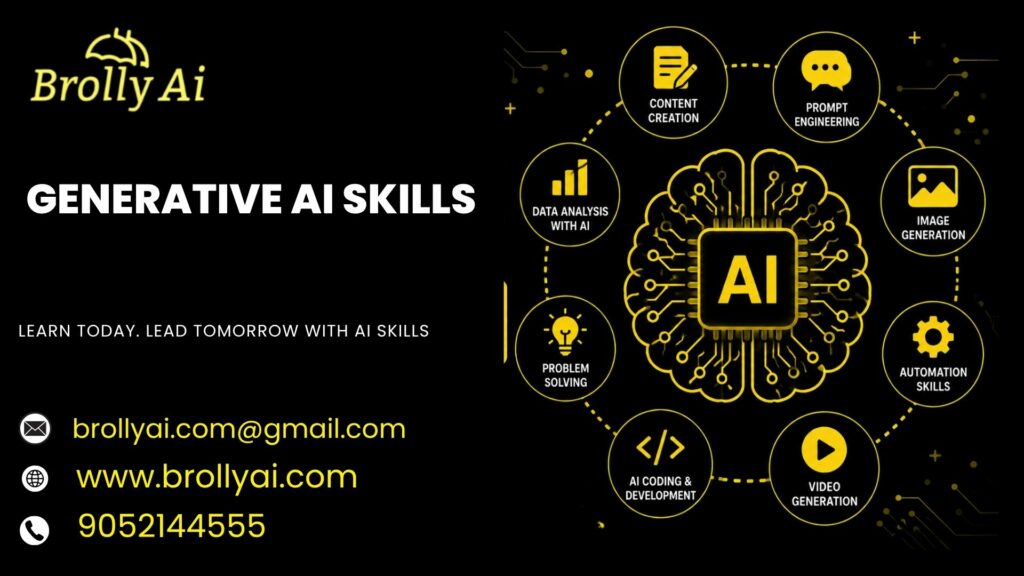
Table of Contents
Generative AI Skills
Generative AI Skills are the practical abilities needed to work with modern AI tools and technologies that can create content, images, code, videos, and more. In this blog, you will learn the most important Generative AI skills in 2026, including Prompt Engineering, Python programming, AI tools, Machine Learning basics, OpenAI APIs, automation, and problem-solving skills. These skills help students and professionals build real-world AI projects, improve productivity, and grow their careers in the fast-changing AI industry. Whether you are a beginner or a working professional, learning Generative AI skills can open new job opportunities and help you stay future-ready in the digital world.
Overview –Generative AI Skills
Generative AI skills are becoming essential for students, developers, marketers, and working professionals in 2026. Learning the right AI skills can help you build real-world projects, improve productivity, and grow faster in the AI industry.
Generative AI Skill | What It Means | Why It Is Important in 2026 | Real-World Use Cases | |
1 | Prompt Engineering | Writing effective prompts to get accurate AI outputs | Helps improve AI results and productivity | ChatGPT content creation, AI automation |
2 | Python Programming | Using Python for AI development and automation | Python is the main language used in AI | AI apps, automation scripts, data processing |
3 | Machine Learning Basics | Understanding how AI models learn from data | Builds strong AI fundamentals | Predictive systems, recommendation engines |
4 | Large Language Models (LLMs) | Learning how models like GPT work | LLMs power most modern AI tools | Chatbots, AI assistants, content generation |
5 | AI Tools Knowledge | Using tools like ChatGPT, Claude, Gemini, Midjourney | Companies expect AI tool expertise | Marketing, coding, designing, research |
6 | OpenAI API Integration | Connecting AI models into websites and apps | Important for AI product development | AI chatbots, AI websites, automation tools |
7 | Data Analysis | Understanding and analyzing data using AI | Data-driven decisions are critical | Business reports, analytics dashboards |
8 | AI Automation | Automating repetitive tasks with AI | Saves time and increases efficiency | Email automation, workflow systems |
9 | Natural Language Processing (NLP) | Teaching AI to understand human language | Core technology behind chatbots | Translation, text summarization |
10 | AI Content Creation | Creating blogs, videos, images, and ads using AI | High demand in digital marketing | SEO blogs, YouTube scripts, ad copy |
11 | AI Image Generation | Creating visuals using AI tools | Visual AI is growing rapidly | Posters, branding, social media graphics |
12 | Problem-Solving Skills | Using logical thinking with AI tools | Needed for real-world AI implementation | Business solutions, AI workflows |
13 | Cloud & AI Deployment | Deploying AI models on cloud platforms | Required for scalable AI applications | AWS AI apps, cloud-based chatbots |
14 | AI Ethics & Security | Understanding responsible AI usage | Important for safe and fair AI systems | Data privacy, ethical AI development |
15 | Communication Skills | Explaining AI ideas clearly to others | Helps in teamwork and presentations | Client meetings, AI project discussions |
These top Generative AI skills can help you stay competitive in the rapidly growing AI job market. By learning these skills step-by-step, you can build a successful career in Artificial Intelligence and future-ready technologies.
Why Generative AI Skills Matter in 2026
“The professionals who learn AI today may lead tomorrow’s industries.”
Generative AI is transforming industries like healthcare, marketing, education, finance, and software development. Companies are rapidly adopting AI tools to automate tasks, improve productivity, and make faster business decisions.
AI Is Transforming Every Industry
Businesses use AI for content creation, customer support, automation, coding, and data analysis. As AI adoption grows, professionals with Generative AI skills are becoming highly valuable across multiple industries.
Why Companies Are Hiring AI-Skilled Professionals
Companies want employees who understand Prompt Engineering, AI tools, automation, and AI-powered workflows. AI-related job opportunities and hiring demand continue to grow significantly in 2026.
The Growing Demand for AI-Powered Productivity
AI helps professionals complete tasks faster and more efficiently. From marketers and developers to designers and analysts, AI-powered productivity is becoming essential in modern workplaces.
How AI Is Changing Traditional Jobs
AI is reshaping traditional careers by changing how work is done. Professionals with AI skills often receive better job opportunities, higher salaries, and stronger career growth in the evolving digital economy.
What Are Generative AI Skills?
Generative AI skills refer to the ability to use AI tools and technologies that can create content such as text, images, videos, audio, and code. These skills help professionals automate tasks, improve productivity, and build AI-powered solutions across different industries.
Difference Between AI, Machine Learning, and Generative AI
- Artificial Intelligence (AI): Machines performing tasks that normally require human intelligence.
- Machine Learning (ML): A branch of AI where systems learn from data and improve automatically.
- Generative AI: An advanced type of AI that creates new content like articles, images, videos, music, and code.
Types of Generative AI Models
Text AI
Generates blogs, emails, captions, chat responses, and marketing content.
Image AI
Creates AI-generated images, designs, artwork, and graphics from text prompts.
Video AI
Produces videos, animations, avatars, and AI-powered visual content.
Audio AI
Generates voiceovers, music, speech synthesis, and AI audio content.
Code Generation AI
Helps developers write, debug, and automate coding tasks faster.
How Generative AI Works in Simple Terms
Generative AI works by learning patterns from large amounts of data. It analyzes information, understands user prompts, and generates new content based on what it has learned. For example, when a user gives a text prompt, the AI predicts and creates the most relevant output within seconds.
Top 15 Generative AI Skills to Learn in 2026
1. Prompt Engineering
Prompt Engineering is one of the most in-demand Generative AI skills in 2026. It involves creating effective prompts to generate accurate AI outputs.
Key concepts include:
- Zero-shot prompting
- Few-shot prompting
- Chain-of-thought prompting
- Prompt optimization
Practical use cases include content writing, AI chatbots, coding assistance, and research automation.
2. Large Language Models (LLMs)
Understanding Large Language Models helps professionals work with advanced AI systems like GPT models and open-source LLMs.
Important topics include:
- GPT model basics
- Open-source AI models
- Tokens and context windows
- Fine-tuning fundamentals
3. AI Agent Development
AI agents can perform tasks autonomously with minimal human involvement.
Key areas include:
- Autonomous AI agents
- Multi-agent systems
- Workflow orchestration
Popular use cases include AI assistants, automated customer support, and business automation.
4. Retrieval-Augmented Generation (RAG)
RAG improves AI responses by connecting models with external knowledge sources.
Important concepts:
- Vector databases
- Semantic search
- Knowledge retrieval systems
5. AI Automation Skills
AI automation helps businesses save time and improve efficiency.
Core skills include:
- Workflow automation
- No-code automation tools
- AI productivity systems
6. Multimodal AI
Multimodal AI can process multiple data types like text, images, audio, and video.
Key technologies:
- Text-to-image AI
- Text-to-video AI
- Voice AI systems
- Vision AI
7. AI Content Creation
AI-powered content creation is transforming digital marketing and media production.
Popular applications:
- SEO content writing
- Social media content
- Video scripting
- Email automation
8. AI Coding & Development
AI development skills help professionals build intelligent applications and automation systems.
Essential topics:
- Python basics
- API integrations
- Building AI applications
9. Data Analysis with AI
AI-powered analytics helps businesses make smarter decisions using data insights.
Important areas:
- AI-driven analytics
- Predictive insights
- Business intelligence
10. AI Ethics & Responsible AI
As AI adoption grows, ethical AI usage becomes increasingly important.
Key concerns include:
- AI bias
- Hallucinations
- Privacy and security
- Responsible AI practices
11. AI Product Thinking
AI product thinking focuses on solving real-world business problems using AI technologies.
Core concepts:
- AI-first product strategy
- AI-based problem solving
12. AI Research Skills
AI research skills help professionals evaluate and improve AI systems.
Important areas:
- Model evaluation
- AI experimentation
- Benchmarking
13. Human + AI Collaboration Skills
Successful professionals will learn how to work effectively with AI tools.
Essential skills:
- Critical thinking
- Creativity
- Communication
- AI supervision
14. AI Sales & Marketing Skills
AI is transforming modern sales and digital marketing strategies.
Key applications:
- Personalized marketing
- AI lead generation
- AI customer targeting
15. AI Entrepreneurship Skills
Generative AI creates new business and freelancing opportunities.
Important areas:
- Building AI startups
- Freelancing with AI
- AI consulting services
Best Generative AI Tools to Learn
Learning the right Generative AI tools is essential for improving productivity, automation, content creation, and AI development skills in 2026. These tools are widely used by businesses, developers, marketers, and creators worldwide.
AI Writing Tools
AI writing tools help generate blogs, emails, social media content, and marketing copy faster and more efficiently.
Popular tools:
AI Coding Assistants
AI coding assistants help developers write, debug, and optimize code more efficiently.
Popular tools:
- Cursor
- GitHub Copilot
- ChatGPT for coding support
AI Automation Platforms
AI automation tools streamline workflows, repetitive tasks, and business operations.
Key uses:
- Workflow automation
- AI productivity systems
- No-code AI automation
AI Image Generators
AI image generation tools create artwork, graphics, branding visuals, and design concepts from text prompts.
Popular tools:
- Midjourney
- DALL·E
- Stable Diffusion
AI Research Tools
AI research tools help users find accurate information, summarize content, and improve research productivity.
Popular tools:
- Perplexity
- ChatGPT
- Gemini
Generative AI Skills Roadmap (Beginner to Advanced)
Beginner Level (1–2 Months)
At the beginner stage, focus on understanding AI fundamentals and learning how to use popular AI tools effectively.
Learn:
- AI basics
- Prompt Engineering
- AI tools and platforms
Intermediate Level (3–6 Months)
At the intermediate level, start building AI workflows and automation systems.
Learn:
- APIs and integrations
- AI automation
- Retrieval-Augmented Generation (RAG)
- AI workflows
Advanced Level (6–12 Months)
Advanced learners should focus on building scalable AI systems and enterprise-level applications.
Learn:
- Fine-tuning AI models
- AI agent development
- Enterprise AI systems
- AI architecture
Generative AI Skills for Different Careers
AI Skills for Developers
Developers should focus on Python, APIs, AI application development, automation, and LLM integration.
AI Skills for Marketers
Marketers can use AI for SEO content creation, personalized campaigns, AI analytics, and customer targeting.
AI Skills for Students
Students can use AI tools for learning, research, productivity, coding practice, and career preparation.
AI Skills for Business Owners
Business owners can leverage AI for automation, customer support, marketing, and operational efficiency.
AI Skills for Designers
Designers can use AI image generators, video AI tools, and creative automation platforms to improve design workflows.
AI Skills for Analysts
Analysts can use AI-powered data analytics, predictive insights, and business intelligence tools to make smarter decisions.
Conclusion
Generative AI is rapidly becoming one of the most important skills in the digital economy. From automation and content creation to coding and business intelligence, AI is transforming how industries operate and how professionals work.
The biggest advantage in 2026 will not come from simply understanding AI theory — it will come from practical implementation. Professionals who can effectively use AI tools, automate workflows, and combine human creativity with AI-powered productivity will stay ahead in the evolving job market.
Key takeaways:
- Generative AI is becoming a must-have skill across industries
- Practical AI skills matter more than theoretical knowledge
- Human creativity combined with AI creates powerful opportunities
- Continuous learning and adaptation are essential for long-term career growth
“AI may not replace humans — but humans using AI will outperform those who don’t.”
Now is the best time to start learning Generative AI skills and prepare for the future of work.
Frequently Asked Questions
Skills used to create content, automate tasks, and solve problems using AI tools.
Prompt Engineering, AI automation, and LLM skills are highly in demand.
Yes, beginners can easily start learning Generative AI tools and basics.
No, coding is not required for beginners, but it helps at advanced levels.
Basic skills can be learned in 1–2 months with regular practice.
AI Engineer, Prompt Engineer, Marketer, Developer, Analyst, and AI Consultant roles.
Yes, it remains one of the most valuable AI skills in 2026.
Generative AI engineers often earn high salaries due to strong industry demand.
Popular tools include ChatGPT, Claude, Gemini, Midjourney, and Cursor.
AI performs intelligent tasks, while Generative AI creates new content like text, images, and code.
Yes, AI helps marketers with SEO, content creation, automation, and targeting.
Yes, many AI tools are beginner-friendly and require no coding knowledge.