Best Generative AI Certification
Looking to future-proof your career with the best generative AI certification 2026? As artificial intelligence rapidly reshapes industries, enrolling in a industry-aligned training program in Hyderabad is key to mastering cutting-edge AI tools, practical hands-on exposure, and real-world projects. Whether you prefer online live classes, hybrid options, or immersive offline classroom learning, choosing the right certification will equip you with the high-demand skills needed to lead in the modern tech landscape.
Share
Table of Contents
Best Generative AI Certification
Generative AI has moved from research labs into everyday hiring requirements faster than almost any other tech skill. Search “Generative AI jobs” on LinkedIn today and you will see the same phrase repeated across postings from startups and enterprises alike: certification preferred. That one line is why so many professionals are now asking a very specific question — not “should I learn Generative AI,” but which certification actually proves I can.
This guide answers that question in full. It covers what a Generative AI certification really is, how it differs from a regular course, what the strongest programs currently look like, what they cost, how to judge whether one is genuinely worth your time and money, and how Brolly AI’s Generative AI Certification in Hyderabad fits into that picture. By the end, you should be able to walk into any enrollment conversation and know exactly what to ask.
What Is a Generative AI Certification?
A Generative AI certification is a formal, tested credential that confirms you can understand and apply generative AI models — the systems behind tools like ChatGPT, Claude, and Gemini — to real tasks such as building prompts, automating workflows, or connecting AI to business data. Unlike a self-paced tutorial or a bookmarked playlist of videos, a genuine certification ends in an assessment: a proctored exam, a graded project, or both.
Employers treat a certification as evidence, not just interest. Anyone can watch a series of videos on generative AI over a weekend; a certification tells a hiring manager that a third party has already checked your work and confirmed you can apply what you learned, not just recall it.
This distinction matters more in Generative AI than in most other fields, because the barrier to “dabbling” is so low. Almost everyone has typed a prompt into ChatGPT. Very few people can reliably design prompts for a business workflow, connect a model to a company’s own documents using retrieval-augmented generation, or build an AI agent that completes a multi-step task without supervision. A certification is what separates the first group from the second, on paper and in practice.
Importance of Generative AI Certification
Beyond the credential itself, generative AI certification matters because of what the underlying skill unlocks across very different parts of the economy. It is not a narrow, single-purpose technical skill — it is closer to a general-purpose capability, the way spreadsheet literacy or basic coding became general-purpose skills in earlier decades.
Boosts creativity. Writers, designers, and marketers use generative AI to explore ideas faster and produce unique creative work, rather than starting every project from a blank page.
Improves efficiency. Businesses automate repetitive work such as writing product descriptions, drafting reports, or summarizing meetings, freeing people up for higher-value work.
Advances research. Scientists and analysts use generative AI to explore hypotheses, model scenarios, and accelerate the early stages of research that used to take far longer manually.
Certification matters here specifically because it is the mechanism that turns “awareness” of these possibilities into “ability” to actually execute them — which is the gap most self-taught learners get stuck in.
Certification vs. Course: Why the Difference Matters
The words “course” and “certification” get used interchangeably in marketing, but they solve different problems. A course teaches. A certification proves what you learned. Understanding this difference before you enroll anywhere will save you both money and disappointment.
| Certification Program | Regular Course | |
|---|---|---|
| Purpose | Validates your Generative AI skills through testing. | Teaches concepts, tools, or techniques. |
| Assessment | Proctored exam or graded project. | Often just completion-based. |
| Recognition | Industry-recognized (issuing institute or platform). | Limited to that platform or instructor. |
| Typical Duration | Several weeks to a few months, structured. | Flexible, often self-paced. |
| Outcome | Professional credential for your résumé. | Certificate of completion. |
| Career Weight | Signals tested, verifiable ability. | Signals exposure to the topic. |
In practice: finishing a free “Intro to Generative AI” playlist is a course. Passing a proctored exam at the end of a structured, project-based program — like Brolly AI’s Generative AI Certification — is a certification. The second one is what shows up meaningfully on a résumé or a LinkedIn profile, because it is backed by an assessment someone else administered, not just a personal claim.
If you are serious about a Generative AI career move, look for a program that combines hands-on projects with a formal evaluation. That combination is what separates a real certification from a glorified course-completion badge wearing a fancier name.
Advantages of Getting Generative AI Certified
It builds professional credibility.
A certification from a recognized institute signals that your skills meet a tested standard, not just a self-reported one. Employers trust that baseline because it has been externally verified, which reduces their hiring risk.
It opens up better roles and pay conversations.
Certified candidates are shortlisted for AI-specific roles more consistently, and certification is increasingly a factor in promotion and compensation discussions for roles that touch AI tooling in any capacity.
It gives you a structured path, not a scattered one.
A good program walks you through core concepts — how generative models like GANs and transformers work, how to prompt reliably, how to connect AI to real data — in a sequence that builds on itself, instead of leaving you to piece it together from scattered videos and forum posts.
It comes with real projects, not just theory.
The strongest certifications require you to build something: a chatbot, a workflow automation, a retrieval-augmented pipeline. That is what turns “I have heard of prompt engineering” into “I have shipped something with it,” which is the sentence that actually gets you hired.
It keeps you current.
Generative AI tooling changes every few months — new models, new frameworks, new best practices. Programs that are actively maintained update their curriculum to match, which matters more here than in almost any other technical field.
It connects you to a community.
Most certification programs include access to peers, mentors, or alumni networks — useful both for problem-solving during the course and for referrals and opportunities afterward.
It gives you a portfolio, not just a certificate.
The projects you build during certification become work samples you can show in interviews, which often matter more to a hiring manager than the certificate itself.
Benefits of Generative AI Certification
Beyond the advantages above, here is the fuller list of concrete gains a genuine certification delivers — useful as a quick checklist if you are trying to justify the investment to yourself or a manager:
- Validation of skills — tangible proof of your expertise for employers or clients, rather than a self-reported claim.
- Competitive advantage — certified candidates stand out in a crowded job market and improve their odds for high-paying roles or projects.
- Career advancement — opens doors to advanced roles across AI research, software development, and data-driven functions.
- Industry recognition — certification from a reputable organization strengthens your professional reputation and credibility.
- Staying updated — well-maintained programs keep you current with the latest generative AI tools and techniques.
- Structured learning — a clear curriculum builds understanding step by step instead of leaving gaps.
- Hands-on experience — practical exercises and projects let you apply theory in real scenarios, not just read about them.
- Networking opportunities — certification programs connect you with a community of professionals for collaboration and knowledge sharing.
- Salary growth — certified professionals often command higher pay than non-certified peers with comparable experience.
- Employer confidence — employers trust certified professionals to contribute effectively from day one.
- Flexibility — certification opens doors across industries and career paths, not just one narrow role.
- Job security — as demand for AI expertise grows, certified skills provide a longer runway of relevance.
How to Choose the Right Certification Program
Before comparing programs by name or price, get clear on the fundamentals that actually determine value:
- Define your goal. Are you trying to break into an AI-specific role, add AI skills to an existing job in marketing, HR, or finance, or build toward technical roles like AI engineering? The right certification looks different for each.
- Check the curriculum in detail, not just the title. “Generative AI Certification” can mean a twenty-hour recorded playlist or a project-heavy, mentor-led program — the same title, wildly different depth. Read the actual syllabus before comparing fees.
- Confirm there is a real assessment. If there is no exam or graded project at the end, you are looking at a course wearing a certification label.
- Look for hands-on project work. Case studies and real datasets separate practical skill from theoretical familiarity, and are what employers actually want to see.
- Check instructor and mentor credentials. Look for people with real industry experience building with generative AI, not just experience teaching from slides.
- Read reviews from past learners, not just testimonials curated on the program’s own landing page.
- Do the cost-benefit math honestly. Add up tuition, materials, and exam fees, and weigh that against the career outcome you are aiming for. A certification is an investment of time and money, not a casual purchase.
Lorem ipsum dolor sit amet, consectetur adipiscing elit. Ut elit tellus, luctus nec ullamcorper mattis, pulvinar dapibus leo.
Top 10 Generative AI Certification Programs Compared
There is no single “best” certification for everyone — the right one depends on your goals, background, and preferred ecosystem. Here is an honest overview of the programs most frequently discussed by learners and professionals right now.
| Program | What It Covers | Best For |
|---|---|---|
| Brolly Generative AI Certification | Practical, project-based training across ChatGPT, Claude, Gemini, prompt engineering, AI agents, RAG, vector databases, with live mentorship. | Freshers, career switchers, and working professionals wanting job-ready, applied AI skills. |
| Google Cloud Professional ML Engineer | Designing, building, and deploying ML models on Google Cloud, including generative techniques like GANs and VAEs. | Google Cloud professionals. |
| Udacity – Deep Learning Nanodegree | Broad deep learning foundation, including generative models. | Beginners to intermediate learners. |
| IBM AI Engineering Professional Certificate | Wide-ranging AI and deep learning overview, including generative AI applications. | Learners wanting broad AI knowledge. |
| Microsoft Azure AI Engineer Associate | Building and deploying AI solutions on Azure, including generative AI. | Microsoft ecosystem professionals. |
| edX Professional Certificate in AI (CS) | Strong AI and CS foundation with generative AI touchpoints. | Academic learners. |
| DeepLearning.AI TensorFlow Developer Certificate | Hands-on TensorFlow including generative models. | Framework-focused learners. |
| AWS Certified AI Practitioner | Foundational AI and generative AI concepts on AWS. | AWS professionals. |
| DeepLearning.AI – Generative AI for Everyone | Conceptual overview of generative AI and business use cases. | Beginners and non-technical professionals. |
| Coursera – GANs Specialization | Deep coverage of Generative Adversarial Networks. | Learners with some AI/ML background. |
Global platform certifications are useful if you already work inside that ecosystem — for instance, an Azure certification carries clear weight if your company already runs on Microsoft’s stack. For learners who want broad, applied, generative-AI-specific skills without being tied to one cloud vendor, a dedicated program with live mentorship and end-to-end projects, such as Brolly AI’s, is usually a more direct path to job readiness.
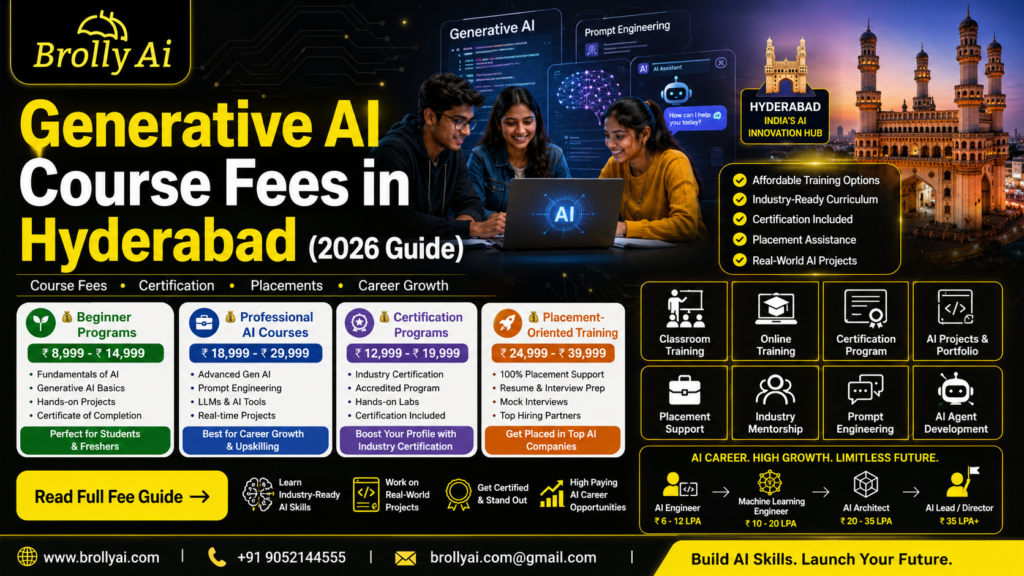
What a Certification Should Actually Cover
A generic “Generative AI” label can hide very different levels of substance. Before enrolling anywhere, confirm the program genuinely includes:
- Foundational models — how tools like ChatGPT, Claude, and Gemini work, and where they meaningfully differ from one another.
- Prompt engineering — designing prompts that produce consistent, accurate results across different models and use cases.
- AI agents — building autonomous, multi-step systems that can complete tasks with minimal supervision.
- Retrieval-Augmented Generation (RAG) — connecting AI outputs to your own data and documents, not just the model’s original training data.
- Vector databases — storing and searching embeddings to power RAG and semantic search.
- API-level integration — calling models programmatically to build your own AI-powered features and applications.
- A capstone or end-to-end project — the piece that turns the whole syllabus into a portfolio-ready deliverable you can actually show an employer.
A program that includes all of this is selling you a genuine, current skill set. One that only covers basic ChatGPT prompting is selling you a fraction of it at the same price point — which is exactly why reading the syllabus matters more than reading the marketing page.
Generative AI Certification Across Industries
Generative AI skills apply differently depending on where you work, and the strongest certification programs reflect that with industry-specific modules or electives.
Software Development. Generative AI accelerates code generation, review, and debugging, letting developers prototype applications faster and spend more time on architecture and creative problem-solving instead of repetitive boilerplate.
Cybersecurity. Security teams use generative AI to detect unusual patterns across large volumes of data, simulate attack scenarios to stress-test defenses, and predict code vulnerabilities before they ship into production.
Business Operations. Generative AI automates report writing, forecasts trends from historical data, and supports faster, better-informed decision-making across departments.
HR and Learning & Development. Teams use it to automate resume screening and onboarding communication, and to build personalized training content matched to individual learning styles.
Finance and Banking. Applications include fraud detection, personalized financial guidance based on customer data, and more accurate risk and forecasting models.
Marketing. Generative AI produces and tests content at scale, personalizes campaigns using customer data, and frees up strategists’ time by automating repetitive tasks like A/B test analysis.
Retail. Retailers use it for demand forecasting, personalized product recommendations, and virtual shopping assistants that improve the online buying experience.
Risk and Compliance. Generative AI helps automate anomaly detection across transactions, contracts, and regulatory documents, reducing the manual burden of compliance monitoring.
Project Management. Project managers use it to assist scheduling, resource allocation, and risk forecasting based on historical project data, freeing time for higher-level strategic work.
If your goal is a specific industry, look for a program with electives or applied projects in that domain rather than a one-size-fits-all curriculum — the difference shows up directly in how quickly you can apply what you learned on the job.
Time Management Strategies for Certification Exam Preparation
Proper time management is often the real difference between learners who finish strong and learners who drift through a program without retaining much. Here is a practical structure that works well for a Generative AI certification timeline:
Create a study plan. Break your material into manageable sections and set specific goals for each session. Build a timeline that covers every topic before the exam date, with buffer time left over for revision.
Prioritize topics. Identify the topics most likely to appear on the exam and study those first. Put extra time into whatever you personally find most challenging, rather than spending equal time everywhere.
Set a regular study schedule. Dedicate consistent hours each day or week and stick to them. Shorter, focused sessions with breaks in between hold concentration far better than long, tiring marathons.
Use a timer. Track how long you spend on each topic so you do not overinvest in one area. The Pomodoro Technique — twenty-five minutes of focused study followed by a five-minute break — is a simple, effective default.
Incorporate review periods. Schedule regular reviews of what you have already studied, and summarize the key points at the end of each week to reinforce understanding and catch gaps early.
Take practice tests. Simulate real exam conditions with full-length, timed practice tests, then analyze your results honestly to adjust your remaining study plan.
Avoid procrastination. Start early rather than cramming at the last minute, and break large study tasks into smaller, less daunting chunks.
Stay organized. Keep your notes, curriculum, and practice material in labeled folders or a simple digital system, and maintain a running to-do list of what still needs covering.
Study Materials and Resources
Useful resources to draw on while preparing for a Generative AI certification:
- “Deep Learning” by Ian Goodfellow, Yoshua Bengio, and Aaron Courville, for foundational theory.
- Hands-on platforms like Kaggle and Google Colab for practice projects and experimentation.
- Official documentation for TensorFlow, PyTorch, and Hugging Face for implementation details.
- Communities such as r/MachineLearning and Stack Overflow for troubleshooting and peer discussion.
- Recorded lectures and conference talks from NeurIPS and ICML for staying current on new techniques.
- Flashcard tools such as Anki or Quizlet for memorizing key terms, algorithms, and concepts.
Brolly AI's Generative AI Certification
Brolly AI’s Generative AI Certification in Hyderabad is built around the “certification, not just a course” standard described throughout this guide: a structured curriculum, live instructor-led sessions, hands-on projects, and a proctored assessment at the end — not just a stack of recorded videos with a certificate attached.
The program covers the practical stack employers are actually hiring for — ChatGPT, Claude, Gemini, Microsoft Copilot, prompt engineering, AI agents, RAG, and vector databases — through real, end-to-end projects rather than isolated exercises, so you finish with a portfolio, not just a transcript.
It is available in three formats to match different schedules and budgets — Online Live, Hybrid, and Offline Classroom — with the same certification, curriculum, and mentorship across all three. The only difference between them is delivery format and the amount of in-person access you get.
If you are comparing this against other Generative AI certification programs, ask any provider the same three questions: Is there a real assessment? Are the projects end-to-end or just isolated exercises? Is the curriculum current with the tools the industry is actually using right now? That is the checklist Brolly AI’s program is built to pass.
Career Outcomes and Salary Growth
One of the most common questions learners ask before committing to a certification is simple: does this actually change my career trajectory? The honest answer is that a certification alone does not guarantee a job or a raise, but it materially improves your odds by giving you two things a self-taught learner usually lacks — a verifiable credential and a portfolio of finished projects.
Professionals who complete a project-based Generative AI certification typically move into one of a few paths: applying generative AI within their existing role, such as a marketer who now owns AI-assisted content workflows or an HR professional who automates screening; transitioning into a dedicated AI-adjacent role such as a prompt engineer or AI operations specialist; or using it as a stepping stone toward more technical roles like AI engineering with further study.
Salary outcomes vary widely by city, company size, and prior experience, so treat any specific figure with caution — but the consistent pattern across the industry is that professionals who can demonstrate applied generative AI skills, backed by real projects, command a premium over peers with the same job title but no AI exposure. That premium is precisely what makes the fee for a genuine, project-based certification look small in hindsight.
How to Compare Certification Programs
Once you have shortlisted a few options, do not compare them on price alone. Score each one across these eight simple criteria, then look at the fee — the best choice is usually the program that scores highest on substance at a fair price, not the cheapest one on the list.
| Criteria | What to Check |
|---|---|
| Real Assessment | Is there a proctored exam or graded project, or just a completion badge? |
| Curriculum Depth | Does it go beyond basic prompting into agents, RAG, and vector databases? |
| Live Instruction | Are classes live and interactive, or fully pre-recorded? |
| Hands-On Projects | Do you build real, end-to-end projects you can show an employer? |
| Tool Coverage | Does it train you on multiple models such as ChatGPT, Claude, and Gemini, not just one? |
| Mentor Support | Can you get your doubts cleared by a real person, not just a forum? |
| Recorded Access | Can you revisit classes later if you are working full-time? |
| Career Outcome | Does the program help with job readiness—portfolio, interview preparation, or placement support? |
| Certification Recognition | Is the certificate recognized by employers or respected within the industry? |
Achieving Success in Generative AI Certification
Achieving success in getting best generative AI certification involves several key steps. Start by choosing the right certification that aligns with your career goals. Build a strong foundation by learning the basics of AI, machine learning, and programming languages like Python. Study generative models such as GANs and transformers and practice using tools like TensorFlow and PyTorch through hands-on projects.
Enroll in online courses like BrollyAI Generative AI Training Institute in Hyderabad, join AI communities, and take mock tests to prepare. Stay updated with the latest advancements in AI, create a study schedule, and thoroughly review all materials before the exam. After certification, apply your knowledge in real-world projects, continue learning, and network with professionals to advance your career
obtaining a best Generative AI certification can provide numerous benefits for individuals in the field, including career advancement, skill development, and industry recognition. By carefully selecting the right certification program, like Brolly AI’s Generative AI Training in Hyderabad, adequately preparing for the exam, and maintaining a commitment to continuous learning, success in the world of Generative AI is within reach.
Conclusion
A certification is worth the money when it changes what you can do, not just what you know. The best Generative AI certification leaves you able to actually build with AI models, design prompts that work reliably, and talk confidently about real-world AI systems — not just recite definitions in an interview.
A thirty-five to forty thousand rupee certification is not an expense when it delivers that. It is one of the better-value investments available right now, in a field where salaries and opportunities are growing fast enough to pay that fee back many times over.
Frequently Asked Questions
1. What is a Generative AI certification?
A tested credential that proves you can understand and use generative AI tools like ChatGPT, Claude, and Gemini, usually through an exam or a graded project, not just watching videos.
2. Why should I get certified instead of just taking a free course?
Because a certification is checked by someone else. Employers trust it more than a self-reported skill, since it shows you have actually been tested and evaluated.
3. Who can join a Generative AI certification program?
Almost anyone — freshers, working professionals, and career switchers. Some advanced programs expect basic Python knowledge, so it is worth checking prerequisites first.
4. What topics does a good certification cover?
Prompt engineering, AI agents, RAG, vector databases, and hands-on projects using tools like ChatGPT, Claude, and Gemini — not just theory.
5. How do I prepare for the certification exam?
Make a simple study plan, focus extra time on your weak topics, review what you have learned every week, and take a few timed practice tests before the real exam.
6. Is there a time limit to finish the certification?
Most structured programs run a few weeks to a few months. Confirm the exact duration with your chosen institute before enrolling.
7. Can I take the certification exam online?
Yes. Most current programs, including live-online formats, let you complete the assessment remotely.
8. What study resources actually help?
A good textbook for the fundamentals, hands-on platforms like Kaggle or Google Colab for practice, and direct mentor support from your program for anything you get stuck on.
9. How much does a Generative AI certification cost?
It varies. Short recorded courses can cost a few thousand rupees. Proper, project-based, mentor-led certifications usually fall between thirty-five thousand and forty thousand rupees.
10. Is the certification recognized outside India?
It depends on the institute. What matters most to employers everywhere is the depth of what you actually learned and built, not just the certificate’s name.
11. How long does the certification stay valid?
Most do not expire on paper. But since AI tools change quickly, it is smart to keep your skills updated every year or two regardless.
12. Can I retake the exam if I do not pass?
Yes, most programs allow a reattempt after a short gap. Check the specific policy with your institute before enrolling.
13. Do I need hands-on project experience to get certified?
You should have it, even where it is not strictly compulsory. A certification without real projects only proves you know the theory, not that you can use it.
14. What jobs can I get with a Generative AI certification?
Roles in AI-assisted development, prompt engineering, and AI-driven work across marketing, finance, HR, and operations, depending on your background and the depth of your training.
15. How do I know if a certification program is actually good?
Check for a real exam or project, live instruction, hands-on work, and honest reviews from past students, not just claims on the website.
16. Do I need a coding background before starting?
No, not for most foundational certifications. A basic comfort with computers is enough to start; some advanced modules benefit from familiarity with Python, but it is usually taught alongside.
17. What is the difference between online, hybrid, and offline training?
Online is fully remote and most flexible. Offline is in-person with direct classroom access. Hybrid blends both. The core curriculum and mentorship are typically identical across all three.
18. Will I get a portfolio I can show employers?
A well-structured certification should include end-to-end projects designed specifically to double as portfolio pieces, not just practice exercises you complete and forget.
19. Does certification guarantee a job?
No certification guarantees a job on its own. What it does is make you a stronger, more credible candidate — the outcome still depends on your effort, interview preparation, and existing experience.
20. How do I choose between similarly priced certification programs?
Compare them on the eight criteria in this guide — assessment, curriculum depth, live instruction, projects, tool coverage, mentor support, recorded access, and career outcome — rather than price alone.