
Deep Learning vs Generative AI
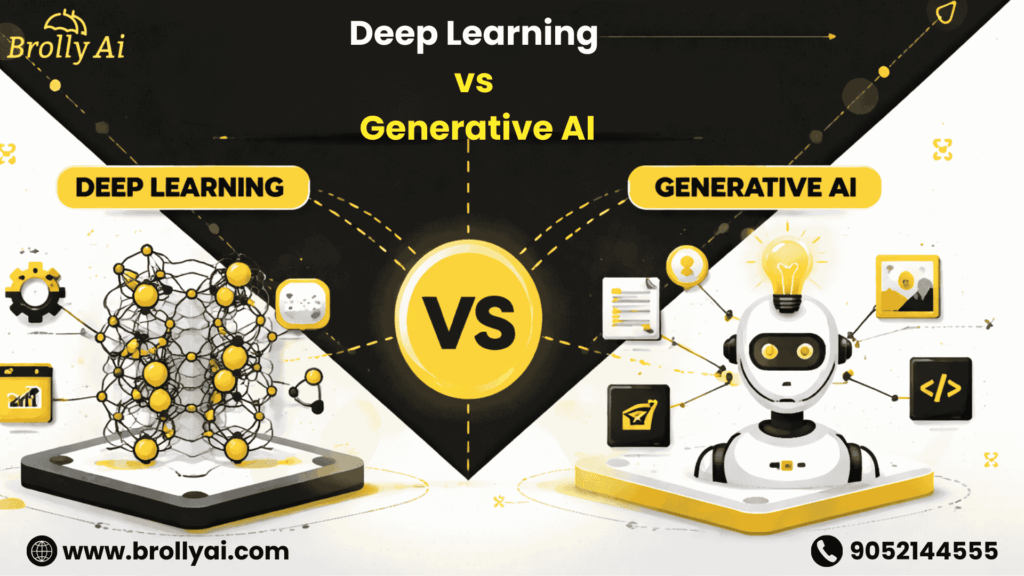
Deep Learning vs Generative AI: What’s the Difference and Which One Should You Learn?
Artificial Intelligence is no longer a futuristic concept. It’s already part of daily life.
From Netflix recommendations to AI-written content, two terms dominate the conversation: Deep Learning and Generative AI.
But here’s the problem.
Most learners, students, and even professionals mix them up.
- Is Generative AI the same as Deep Learning?
- Is Deep Learning outdated now that tools like ChatGPT exist?
- Which one should you actually learn in 2025–2026?
If you’re looking for clear answers to these questions, this guide is built for you.
This guide breaks everything down clearly, practically, and without unnecessary jargon. By the end, you’ll understand
- What Deep Learning really is
- What Generative AI actually does
- How they differ
- How they work together
- Which skill makes sense for your learning goals
Let’s start with the biggest source of confusion.
Why Do People Confuse Deep Learning and Generative AI?
The confusion between Deep Learning and Generative AI didn’t happen by accident. It’s the result of buzzwords, media hype, and rapid AI innovation.
Here’s why this mix-up is so common.
1. AI Tools Are Marketed, Not Explained
When people use tools like:
- AI chatbots
- Image generators
- Music creation tools
They’re usually told:
“This is AI.”
Not:
“This tool uses Generative AI technology that is powered by Deep Learning models.”
The technical foundation gets hidden behind user-friendly interfaces.
2. Generative AI Is Built on Deep Learning (But Not the Same Thing)
This is the core reason for confusion.
- Deep Learning is a technology and method.
- Generative AI is a type of application.
Think of it like this:
Deep Learning is the engine.
Generative AI is the car that uses that engine.
Because Generative AI relies heavily on Deep Learning models, many people assume they are interchangeable — but they are not.
3. Media and Social Platforms Blur the Definitions
Articles, videos, and posts often say things like:
- “Deep learning wrote this article.”
- “AI created this artwork.”
- “This model thinks like a human.”
In reality
- Deep Learning learns patterns
- Generative AI creates new content using those patterns.
That distinction rarely gets explained.
4. A Simple Example Most People Relate To
Let’s use a very simple comparison.
- A Deep Learning model trained on images of cats can:
- Identify whether an image contains a cat.
- Classify breeds
- Detect objects
- A Generative AI model trained on cat images can:
- Create new images of cats.
- Generate variations that never existed before
Both use neural networks.
But their goals are completely different.
5. Learners Search for “Deep Learning vs Generative AI” for a Reason
Most people searching this topic want clarity, not theory.
They want to know
- What’s the real difference?
- Do I need to learn both?
- Which one helps my career more?
- Is Deep Learning still relevant in 2026?
That’s exactly why this comparison matters.
Key Takeaway from This Section
Before going deeper, remember this.
- Deep Learning is a foundational AI technique that learns patterns from data.
- Generative AI is a category of AI systems that create new content.
- Generative AI depends on Deep Learning, but Deep Learning does much more than generation.
In the next section, we’ll build a strong foundation by answering the most important question first:
What Is Deep Learning in Simple Terms?
Deep Learning is one of those concepts that sounds intimidating at first.
But at its core, it’s surprisingly logical.
Deep Learning is a method that enables computers to learn patterns from large datasets using layered neural networks.
Instead of being told exact rules, the system learns by example, much like humans do.
How Does Deep Learning Actually Work?
Let’s break this down without math or heavy theory.
A deep learning system works in three basic steps:
- It takes input data
- Processes it through multiple layers
- Produces an output or decision
Each layer learns something slightly more complex than the previous one.
A Simple, Real-World Example
Imagine teaching a computer to recognize handwritten numbers (0–9).
- The first layer notices simple lines and edges.
- The middle layers combine lines into shapes.
- The final layer recognizes full digits.
The computer doesn’t “understand” numbers like humans do.
It learns patterns from thousands or millions of examples.
This layered learning is why it’s called deep learning.
What Are Neural Networks, Really?
Neural networks are the backbone of deep learning.
They are inspired by the human brain, but they are much simpler in reality.
A neural network is made of
- Nodes (neurons) – small processing units
- Connections (weights) – decide how important an input is
- Layers – where learning happens step by step
Each neuron asks a basic question:
“Should I pass this information forward, or not?”
Over time, the network adjusts itself to make better decisions.
What Happens During Training?
Training is where the learning happens.
Here’s what training looks like in practice
- The model makes a prediction
- It compares the prediction to the correct answer.
- It calculates how wrong it was
- It adjusts its internal values.
- This process repeats thousands or millions of times.
This feedback loop is what allows deep learning models to improve.
High-quality data directly translates into more accurate and reliable results.
Key Concepts Behind Deep Learning
Here are the most important ideas you need to understand — explained simply.
- Training data
The examples the model learns from - Loss function
A way to measure how wrong the model is - Optimization
The process of improving accuracy over time - Inference
Using a trained model to make predictions
You don’t need to master the math to understand the concept.
What Types of Neural Network Architectures Are Common?
Different problems need different network designs.
Here are the most widely used architectures in deep learning today.
Common Deep Learning Architectures
Architecture | Best Used For | Simple Explanation |
CNNs (Convolutional Neural Networks) | Images & video | Learn visual patterns like shapes and edges |
RNNs (Recurrent Neural Networks) | Sequences & time-series | Remember past information |
Transformers | Language & multimodal data | Understand context and relationships |
Transformers deserve special mention because they power many modern AI systems, including language models.
Frameworks like TensorFlow and PyTorch make it easier for learners and professionals to build these networks without starting from scratch.
Where Is Deep Learning Used Today?
Deep learning is already everywhere, even if you don’t notice it.
Common examples include
- Face recognition on smartphones
- Voice assistants understand speech.
- Recommendation systems on streaming platforms
- Medical image analysis
Importantly, deep learning is not limited to content creation.
That’s where many people confuse it with Generative AI.
Why Deep Learning Still Matters in 2026
Even with the rise of Generative AI, deep learning remains essential.
Why?
- It’s the foundation of modern AI.
- It powers both predictive and generative systems.
- Every advanced AI model still relies on deep neural networks.
If you remove deep learning, most Generative AI systems simply won’t work.
Key Takeaways
- Deep Learning teaches machines to learn patterns from data.
- Neural networks are layered systems that improve through training.
- It focuses on prediction, classification, and understanding data.
- Deep Learning forms the technological backbone of Generative AI systems.
Now that you understand Deep Learning clearly, the next step is to explore the other side of the comparison.
What Is Generative AI and How Is It Different?
Now that you understand Deep Learning, it’s time to explore the term that’s dominating headlines, social media, and workplace conversations: Generative AI.
Unlike Deep Learning, which focuses on learning patterns and making predictions, Generative AI focuses on creating something entirely new.
That single difference changes everything.
What Does Generative AI Actually Do?
Generative AI refers to a class of AI systems that can generate new content after learning from existing data.
Instead of answering questions like:
- “Is this image a cat or a dog?”
- “Will this transaction be fraudulent?”
Generative AI answers questions like:
- “Write a paragraph about climate change.”
- “Create an image of a futuristic city.”
- “Compose a short piece of music.”
The output didn’t exist before.
The AI creates it based on patterns learned from massive datasets.
A Simple Example Anyone Can Understand
Let’s compare Deep Learning and Generative AI using a writing task.
- A Deep Learning model trained on text might:
- Predict the next word.
- Classify emails as spam or not spam.
- Analyze sentiment
- A Generative AI model trained on text can:
- Write full blog posts.
- Generate emails
- Create stories, scripts, or code.
The key difference is creation, not just analysis.
Predictive AI vs Generative AI (Quick Clarity)
This distinction is critical.
- Predictive AI (Deep Learning)
→ Learns patterns to predict or classify - Generative AI
→ Learns patterns to create new data
Generative AI doesn’t just recognize patterns.
It samples from learned distributions to produce original outputs.
What Are the Core Principles of Generative AI?
Generative AI systems are built on a few foundational ideas.
Here’s what’s happening under the hood — explained simply.
- Learning data distributions
The model learns how data is structured, not just labels. - Probability-based generation
Outputs are based on likelihood, not hard rules. - Creativity through variation
Small changes in input can produce different results.
This is why two prompts can generate two completely different outputs — even from the same model.
Is Generative AI Really “Creative”?
This is a common question.
Generative AI does not think or imagine the way humans do.
Its “creativity” comes from recombining learned patterns in new ways.
Think of it as:
A powerful pattern remixing engine — not human imagination.
Still, the results can feel creative, impressive, and even surprising.
Popular Examples of Generative AI in Action
You’ve probably interacted with Generative AI already, even if you didn’t realize it.
Common examples include
- AI chatbots that write text
- Image generators that create artwork
- Music tools that compose melodies
- Code assistants that suggest functions
Platforms like Midjourney have made generative models accessible to non-technical users, accelerating adoption across industries.
What Generative AI Is NOT
To avoid confusion, it’s important to clear up a few misconceptions.
Generative AI
- It is not a replacement for human judgment
- It is not always accurate or factual
- Does not understand the meaning or intent
It generates outputs that look correct based on training data — not because it knows the truth.
This limitation becomes important when we discuss challenges later in the blog.
How Generative AI Depends on Deep Learning
Here’s the connection point.
Almost all modern Generative AI systems rely on:
- Deep neural networks
- Large-scale training
- Advanced architectures like transformers
Without Deep Learning, today’s Generative AI simply wouldn’t exist.
That’s why learning Deep Learning fundamentals still matters — even if your goal is Generative AI.
Key Takeaways
- Generative AI focuses on creating new content, not just predictions
- It learns from data distributions and generates original outputs.
- Deep Learning is the foundation, not the competitor.
- Generative AI tools feel creative but rely on statistical patterns.
With both concepts now clearly defined, it’s time to connect the dots and see how Deep Learning actually powers Generative AI behind the scenes.
How Is Deep Learning Used Inside Generative AI?
At this point, one important truth should be clear:
Generative AI does not replace Deep Learning — it is built on top of it.
This section connects the dots and explains how Deep Learning actually powers Generative AI systems behind the scenes.
Can Generative AI Exist Without Deep Learning?
In theory, simple generative systems existed before deep learning.
For example:
- Rule-based text generators
- Template-driven chatbots
- Basic statistical models
But these systems were:
- Rigid
- Limited
- Not scalable
- Easily predictable
Modern Generative AI — the kind that writes essays, creates images, or composes music — cannot function without Deep Learning.
Why?
Because
- Deep Learning can learn complex, high-dimensional patterns
- It scales to massive datasets.
- It adapts to language, images, audio, and code.
Without deep neural networks, today’s Generative AI simply wouldn’t exist.
The Role of Neural Networks in Generative AI Systems
In Generative AI, neural networks act as pattern learners and content creators.
Instead of learning:
- “This image is a cat.”
They learn
- “This is what cats usually look like.”
That difference allows the model to
- Generate new images of cats
- Write new sentences
- Create variations that never appeared in training data.
The network captures structure, not just labels.
Which Deep Learning Techniques Power Generative AI?
Several deep learning techniques are especially important for generative systems.
Here are the most relevant ones you should understand.
1. Transformers
Transformers are the backbone of most modern Generative AI systems.
They are excellent at
- Understanding context
- Handling long sequences
- Processing data in parallel
That’s why they power large language models and multimodal AI systems.
2. Autoencoders
Autoencoders learn to
- Compress data into smaller representations
- Reconstruct it accurately
In Generative AI, this ability is used to:
- Learn latent representations
- Generate variations of data.
They play a key role in models like VAEs.
3. Generative Adversarial Networks (GANs)
GANs use two neural networks working against each other:
- A generator (creates content)
- A discriminator (judges quality)
This competition helps improve output realism, especially in image generation.
How Deep Learning Enables “Creativity” in Generative AI
What feels like creativity is actually probabilistic pattern generation.
Deep Learning enables this by
- Modeling relationships between features
- Learning subtle variations
- Allowing controlled randomness
This is why
- The same prompt can produce different results
- Outputs feel natural rather than repetitive.
Creativity emerges from complex pattern learning, not consciousness.
Deep Learning vs Generative AI: Relationship Summary
To simplify the relationship, here’s a clear comparison.
Relationship Table: Deep Learning and Generative AI
Aspect | Deep Learning | Generative AI |
Role | Core learning technique | Application layer |
Purpose | Learn patterns | Create new content |
Dependency | Independent | Depends on DL |
Scope | Broad (vision, speech, prediction) | Narrower (content generation) |
Longevity | Foundational | Rapidly evolving |
This table reinforces an important idea:
Learning Generative AI without understanding Deep Learning is like driving a car without knowing what an engine does.
Why This Relationship Matters for Learners
If you’re planning to upskill, this insight is crucial.
- Deep Learning gives you long-term fundamentals.
- Generative AI gives you high-impact, applied skills.
- Together, they offer the strongest career flexibility.
Professionals who understand both can:
- Build better systems
- Troubleshoot model behavior
- Adapt as tools evolve.
Key Takeaways
- Generative AI relies heavily on Deep Learning
- Neural networks learn data structure, not just labels.
- Transformers, autoencoders, and GANs power modern systems
- Deep Learning is the foundation, Generative AI is the application.
Now that the relationship is clear, we can finally compare them side by side in a structured way.

Deep Learning vs Generative AI: What Are the Key Differences?
Now that you understand what Deep Learning is, what Generative AI is, and how they are connected, let’s answer the question most readers actually come for:
How are Deep Learning and Generative AI different in practice?
While they are closely related, they solve very different problems and are used in different ways.
How Do Their Goals and Outputs Differ?
The biggest difference lies in what each one is designed to do.
- Deep Learning focuses on:
- Learning patterns
- Making predictions
- Classifying or recognizing data
- Generative AI focuses on:
- Creating new content
- Generating text, images, audio, or code
- Producing original outputs that didn’t exist before
In simple terms:
Deep Learning understands data.
Generative AI creates with data.
How Do Training Approaches and Data Requirements Compare?
Both depend on data, but they use it in different ways.
- Deep Learning models often require:
- Labeled datasets
- Clear objectives (classification, prediction)
- Structured evaluation metrics
- Generative AI models typically require:
- Massive, diverse datasets
- Less explicit labeling
- More compute-intensive training
Generative AI models also tend to be much larger and more expensive to train.
How Do Complexity and Use Cases Differ?
Another major difference is complexity and scope.
- Deep Learning systems are often:
- Task-specific
- Easier to evaluate
- More predictable
- Generative AI systems are:
- Open-ended
- Harder to control
- More flexible, but less predictable
This is why Generative AI requires additional safeguards, prompt design, and evaluation methods.
Deep Learning vs Generative AI: Core Comparison Table
This table summarizes the differences clearly.
Feature | Deep Learning | Generative AI |
Primary Goal | Learn patterns and make predictions | Create new content |
Output Type | Labels, scores, classifications | Text, images, audio, code |
Dependency | Standalone AI technique | Built on Deep Learning |
Data Needs | Large, often labeled datasets | Massive, diverse datasets |
Model Size | Small to large | Usually very large |
Predictability | High | Lower |
Evaluation | Accuracy, precision, recall | Quality, coherence, usefulness |
Examples | Image recognition, fraud detection | Chatbots, image generation |
Which One Is “Better”? (The Wrong Question)
Many learners ask:
“Deep Learning vs Generative AI: Which One Is Better?”
The honest answer is:
Neither is better. They serve different purposes.
- If you need accurate predictions, Deep Learning is ideal.
- If you need creative output, Generative AI is the right choice.
- In many real-world systems, both are used together.
What This Difference Means for Careers
Understanding this distinction helps you make smarter learning decisions.
- Deep Learning skills are:
- Foundational
- Long-lasting
- Valuable across many industries
- Generative AI skills are:
- High-impact
- Fast-evolving
- Closely tied to tools and platforms
Professionals who understand the difference and the connection are far more adaptable in the AI job market.
Key Takeaways
- Deep Learning focuses on understanding and prediction.
- Generative AI focuses on creation and generation.
- Generative AI depends on Deep Learning.
- Both are essential — but for different goals.
Now that the comparison is clear, it’s time to explore how Generative AI actually works under the hood by looking at the main types of generative models.
What Are the Main Types of Generative Models?
Generative AI uses multiple model types rather than a single architecture.
Instead, it relies on different generative models, each designed for specific kinds of data and use cases.
Understanding these models helps you move beyond buzzwords and see how Generative AI actually works.
What Are GANs and Why Are They Important?
Generative Adversarial Networks (GANs) are one of the earliest and most influential generative models.
They work using two neural networks:
- Generator – creates fake data
- Discriminator – determines whether the output is authentic or artificial.
During training, the two networks constantly challenge each other.
Over time
- The generator improves at creating realistic data
- The discriminator improves at detecting fake data.
This competition leads to highly realistic outputs.
Simple Example of GANs
Imagine an art student and a strict art teacher.
- The student creates paintings.
- The teacher critiques them.
- The student improves based on feedback.
GANs work similarly.
Where GANs Are Commonly Used
- AI-generated images
- Face generation
- Style transfer
- Synthetic data creation
GANs were groundbreaking, but they can be hard to train and unstable.
What Are VAEs and How Are They Different?
Variational Autoencoders (VAEs) take a different approach.
Instead of competing networks, VAEs focus on
- Learning a compressed representation of data
- Generating new samples from that representation
They consist of
- An encoder (compresses data)
- A decoder (reconstructs or generates data)
Why VAEs Matter
VAEs are
- More stable during training
- Easier to control
- Better for structured generation
However, their outputs can sometimes appear less sharp compared to GANs.
Common VAE Use Cases
- Data generation
- Anomaly detection
- Feature learning
- Recommendation systems
Why Are Diffusion Models So Popular Today?
Diffusion models are currently one of the most important trends in Generative AI.
They work by:
- Gradually adding noise to data
- Learning how to reverse the noise
- Reconstructing realistic data step by step
This slow refinement process produces high-quality and diverse outputs.
Diffusion models power many modern image-generation tools, including platforms like Stable Diffusion.
Why Diffusion Models Are Gaining Popularity
- More stable training than GANs
- High-quality outputs
- Strong control over generation
The trade-off is that they can be slower during generation.
Generative Model Comparison Table
This table summarizes the strengths and weaknesses clearly.
Model Type | Main Strength | Main Limitation | Best Use Case |
Highly realistic outputs | Difficult to train | Image generation | |
VAEs | Stable and controllable | Slightly blurrier results | Structured data |
Diffusion Models | High-quality and diverse outputs | Slower sampling | Art & design |
Which Generative Model Should You Learn First?
For learners, the goal is understanding concepts, not mastering everything at once.
A practical approach:
- Start with basic autoencoders
- Learn GANs for intuition.
- Explore diffusion models for modern applications.
Most modern tools abstract these details, but knowing the basics helps you:
- Choose the right model
- Troubleshoot issues
- Understand limitations
Key Takeaways
- Generative AI uses multiple model types.
- GANs focus on competition.
- VAEs focus on representation.
- Diffusion models dominate modern image generation.
- Each model has trade-offs.
Now that we understand how generative models work, it’s time to see where Deep Learning and Generative AI are used in the real world.
Where Is Deep Learning Used in Real-World Applications?
Deep Learning isn’t just a research topic or a buzzword.
It’s a quiet workhorse behind many technologies people use every day.
While Generative AI gets more attention, Deep Learning powers some of the most critical systems in modern industries.
How Is Deep Learning Used in Healthcare?
Healthcare is one of the most impactful areas for Deep Learning.
Deep learning models are used to
- Analyze medical images (X-rays, MRIs, CT scans)
- Detect diseases earlier than traditional methods.
- Assist doctors with diagnosis and treatment planning.
Example:
Deep Learning systems can identify signs of cancer in imaging scans by learning from thousands of labeled medical images.
This doesn’t replace doctors.
It helps professionals make quicker, more reliable decisions.
How Does Deep Learning Power Computer Vision?
Computer vision is one of the earliest success stories of Deep Learning.
Deep Learning models are used for:
- Face recognition
- Object detection
- Image classification
- Autonomous vehicles
Self-driving systems rely heavily on deep learning to:
- Detect pedestrians
- Recognize traffic signs
- Understand road conditions
Here, accuracy and reliability matter more than creativity, which is why Deep Learning is ideal.
How Is Deep Learning Used in Finance and Fraud Detection?
In finance, Deep Learning focuses on pattern recognition at scale.
Common applications include:
- Fraud detection
- Credit risk assessment
- Algorithmic trading
- Customer behavior analysis
Deep learning models can detect unusual transaction patterns that humans might miss — even in massive datasets.
How Do Recommendation Systems Use Deep Learning?
Recommendation engines are a powerful but often invisible use of Deep Learning.
They analyze
- User behavior
- Preferences
- Interaction history
Then they predict what you might like next.
Examples include
- Streaming platforms recommending shows
- Online stores suggest products.
- Learning platforms are personalizing content.
These systems rely on prediction, not generation — making Deep Learning the perfect fit.
Why Deep Learning Remains Critical Across Industries
Deep Learning excels when systems need to:
- Be accurate
- Be consistent
- Work at scale
- Handle structured decision-making
This is why it’s used in:
- Manufacturing quality control
- Energy optimization
- Speech recognition
- Cybersecurity
Even as Generative AI grows, Deep Learning remains foundational in enterprise AI systems.
Key Takeaways
- Deep Learning powers high-stakes, real-world systems.
- It excels at prediction, detection, and classification.
- Healthcare, finance, and vision rely heavily on Deep Learning.
- Not all AI needs to generate content.
Next, we’ll explore where Generative AI shines — especially in creative and open-ended tasks.
Where Is Generative AI Used Across Industries?
While Deep Learning focuses on prediction and analysis, Generative AI shines when creativity, speed, and flexibility matter.
Over the last few years, Generative AI has moved from research labs into real workplaces, changing how people create, design, and build.
How Is Generative AI Used in Content Creation?
Content creation is one of the most visible applications of Generative AI.
Generative AI tools can:
- Draft blog posts and articles
- Write marketing copy and emails.
- Generate social media captions.
- Summarize long documents
For businesses, this means
- Faster content production
- Reduced manual effort
- Better consistency at scale
For individuals, it means:
- Overcoming writer’s block
- Improving productivity
- Getting first drafts quickly
The key is human review and editing — Generative AI supports creators, it doesn’t replace them.
How Is Generative AI Used in Art and Design?
Generative AI has opened new doors for artists and designers.
It’s commonly used for
- Concept art and illustrations
- Branding visuals
- UI and UX inspiration
- Rapid prototyping
Designers can generate dozens of ideas in minutes, then refine the best ones.
Tools like DALL·E demonstrate how text prompts can turn into detailed visuals.
How Is Generative AI Used in Music and Creative Expression?
Music is another area where Generative AI is making an impact.
Generative AI can
- Compose background music
- Assist with melody creation.
- Generate sound effects
- Help musicians experiment with new styles.
Rather than replacing artists, these tools act as creative collaborators, helping musicians explore ideas faster.
How Is Generative AI Used in Software Development and Automation?
In software development, Generative AI improves productivity.
Common use cases include
- Code generation
- Code explanation
- Bug fixing assistance
- Documentation creation
Developers use Generative AI as a coding assistant, not a replacement.
This reduces repetitive work and lets engineers focus on problem-solving.
Why Generative AI Is Spreading So Fast
Generative AI adoption is growing rapidly because it:
- Requires less technical setup for users
- Works across industries
- Produces immediate, visible results
However, this flexibility also introduces risks, which we’ll explore next.
Key Takeaways
- Generative AI excels in creative and open-ended tasks.
- It supports content creation, design, music, and coding.
- Humans remain essential for judgment and quality control.
- Generative AI complements, not replaces, expertise.
Now that we’ve seen where both technologies are used, it’s time to talk about their limitations and challenges.
What Challenges Do Deep Learning and Generative AI Face?
Despite their impressive capabilities, Deep Learning and Generative AI are not perfect.
Understanding their challenges helps learners, businesses, and professionals use them responsibly and effectively.
Let’s look at the issues they face—both shared and unique.
What Are the Common Challenges in Deep Learning?
Deep Learning systems are powerful, but they come with real constraints.
1. Why Does Deep Learning Require So Much Data?
Deep Learning models learn patterns from examples.
The more complex the task, the more data they need.
Challenges include
- Collecting large, high-quality datasets
- Labeling data (often expensive and time-consuming)
- Handling biased or incomplete data
Without enough good data, even advanced models perform poorly.
2. Why Is Deep Learning So Computationally Expensive?
Training deep neural networks often requires:
- High-performance GPUs or TPUs
- Long training times
- Significant energy consumption
This creates barriers for
- Small companies
- Students and independent learners
- Organizations with limited infrastructure
3. Why Is Deep Learning Hard to Explain?
Many deep learning models act like black boxes.
- They produce accurate results.
- But explaining why they made a decision is difficult.
This lack of interpretability is a serious concern in areas like:
- Healthcare
- Finance
- Law
Trust and accountability matter, not just accuracy.
What Challenges Are Unique to Generative AI?
Generative AI introduces a different set of problems, especially because it creates content.
1. Why Does Generative AI “Hallucinate”?
Generative AI can produce information that:
- Sounds confident
- Looks realistic
- But it is factually incorrect.
This happens because
- The model predicts likely outputs
- It does not verify truth.
These hallucinations can be risky in education, journalism, and healthcare.
2. How Does Bias Appear in Generative AI Outputs?
Generative AI learns from human-created data.
If the data contains
- Bias
- Stereotypes
- Unequal representation
The model can reproduce or amplify those issues.
Bias mitigation remains one of the biggest open challenges in AI.
3. What Are the Ethical and Copyright Concerns?
Generative AI raises new questions.
- Who owns AI-generated content?
- Is it ethical to train models on public data without consent?
- How should AI-generated work be labeled?
These questions are driving global discussions on AI governance and regulation.
Shared Challenges: Where Both Technologies Struggle
Both Deep Learning and Generative AI face overlapping issues.
- High energy usage
- Environmental impact
- Data privacy concerns
- Need for responsible deployment.
As AI becomes more powerful, these challenges become more important—not less.
Why These Challenges Matter for Learners
If you’re learning AI-related skills, this section matters because:
- Employers value responsible AI awareness
- Understanding limitations makes you a better practitioner.
- Ethical knowledge is becoming a core skill.
Future AI professionals won’t just build systems — they’ll be expected to build them responsibly.
Key Takeaways
- Deep Learning struggles with data, cost, and interpretability
- Generative AI struggles with hallucinations, bias, and ethics.
- Both require careful, responsible use.
- Understanding limitations builds credibility and trust.
Now that we’ve covered strengths and weaknesses, it’s time to help readers make a practical decision.
Deep Learning vs Generative AI: Which One Should You Learn First?
This is one of the most important questions learners ask — and the answer depends on your background, goals, and timeline.
There is no one-size-fits-all path.
But there is a smart way to decide.
Who Should Start With Deep Learning?
Deep Learning is ideal if you want strong, long-term AI foundations.
You should start with Deep Learning if you
- Are you a student or beginner in AI or data science
- Want to understand how AI works under the hood.
- Plan to work in healthcare, finance, robotics, or research.
- Prefer structured problem-solving over creative generation.
Why this path works
- Deep Learning skills are transferable across industries
- Concepts remain relevant even as tools change.
- It builds the mindset needed to understand advanced AI systems.
Deep Learning teaches you why models behave the way they do.
Who Should Start With Generative AI?
Generative AI is ideal if you want fast, practical impact.
You should start with Generative AI if you
- Are you a professional looking to upskill quickly
- Work in content, marketing, design, or software
- Want to use AI tools rather than build models from scratch.
- Need productivity gains more than theoretical depth.
Why this path works
- Lower technical barrier to entry
- Immediate real-world applications
- High demand across many roles
Generative AI teaches you how to apply AI effectively.
Learning Path Comparison: Beginner to Professional
This table gives a clear learning roadmap.
Stage | Deep Learning Focus | Generative AI Focus |
Beginner | Python, ML basics, neural networks | Prompting, AI tools, use cases |
Intermediate | CNNs, RNNs, Transformers | GANs, diffusion models, fine-tuning |
Advanced | Model optimization, deployment | Custom models, responsible AI |
The Smart Hybrid Approach
For most learners in 2025–2026, the best strategy is not choosing one over the other.
A smart path looks like this
- Learn Deep Learning fundamentals
- Apply them through Generative AI tools and models.
- Focus on real-world problem solving.
This gives you
- Conceptual depth
- Practical relevance
- Career flexibility
What Employers Will Look for by 2026
By 2026, employers will value professionals who:
- Understand AI fundamentals
- Can apply Generative AI responsibly
- Know limitations and risks.
- Adapt quickly as tools evolve.
Pure tool users or pure theorists will struggle.
Balanced learners will thrive.
Key Takeaways
- Deep Learning builds strong AI foundations.
- Generative AI delivers fast, visible results.
- Your choice depends on goals, not hype.
- A combined learning path is the most future-proof.
We’re almost done. In the final section, we’ll look ahead and explore how Deep Learning and Generative AI will evolve by 2026, followed by FAQs and a strong wrap-up.
How Will Deep Learning and Generative AI Evolve by 2026?
AI is evolving fast, but the next phase won’t just be about bigger models.
By 2026, the focus will shift toward efficiency, responsibility, and real-world integration.
Let’s look at the most important trends shaping the future of Deep Learning and Generative AI.
1. Multimodal AI Will Become the Standard
Future AI systems won’t handle just one type of data.
They will
- Understand text, images, audio, and video together
- Respond more naturally to human input.
- Power smarter assistants and applications
Deep Learning will continue to provide the architecture, while Generative AI will drive content creation across multiple formats.
2. Smaller, More Efficient Models Will Gain Importance
Instead of always scaling up, AI development will focus on:
- Smaller models
- Lower compute requirements
- On-device AI (phones, wearables, edge devices)
This shift makes AI
- More affordable
- More accessible
- More environmentally sustainable
Efficiency will become a competitive advantage.
3. Generative AI Will Become a Daily Work Companion
By 2026, Generative AI won’t feel “special” anymore.
It will be
- Integrated into productivity tools
- Embedded in design and coding platforms
- Used as AI copilots across industries
Rather than replacing jobs, it will reshape workflows.
4. Responsible and Regulated AI Will Take Center Stage
As AI adoption grows, so will oversight.
Key developments include
- Stronger AI regulations
- Transparency requirements
- Ethical guidelines for deployment
Organizations and professionals who understand responsible AI practices will be in high demand.
5. Personalized AI Learning and Education
AI will transform education itself.
Expect
- Personalized learning paths
- AI tutors are adapted to individual pace.
- Skill-focused, just-in-time learning
Deep Learning models will analyze learning behavior, while Generative AI will customize explanations and content.
Why These Trends Matter for Learners
These changes mean
- Fundamentals matter more than tools
- Adaptability is a core skill.
- Understanding limitations builds trust.
Those who learn how AI works — not just how to use it — will stay relevant.
Key Takeaways
- Multimodal AI will dominate by 2026
- Smaller, efficient models will rise.
- Generative AI will become a daily assistant.
- Ethics and regulation will shape AI adoption.
- Education itself will be AI-powered
We’re now ready to wrap up with FAQs and a strong conclusion that reinforces clarity and action.
Final Thoughts: Deep Learning vs Generative AI — What Truly Matters
If there’s one key takeaway from this guide, it’s simple:
Deep Learning and Generative AI are not competitors — they work together.
Deep Learning forms the core foundation of modern AI.
Generative AI sits on top of that foundation, turning learned patterns into meaningful content and outputs.
Deep Learning enables machines to:
- Recognize patterns in data
- Make accurate predictions
- Learn from both structured and unstructured information
Generative AI builds on that capability to:
- Generate text, images, music, and code
- Support humans in creative and knowledge-driven work
- Speed up tasks across industries and roles
So, Which One Should You Focus On?
Instead of debating which is better, a smarter question to ask is:
- What are you trying to build or accomplish?
- Do you need deep technical understanding, or quick, practical results?
- Are you aiming for long-term AI expertise or immediate productivity gains?
Your answers will guide the right learning path.
The Most Future-Proof Approach
Looking ahead to 2025 and beyond, the smartest strategy is clear:
- Learn Deep Learning fundamentals to understand how AI systems work
- Apply that knowledge through Generative AI tools and models
- Prioritize responsible, ethical, and real-world usage
By 2026, AI careers will favor people who:
- Understand the fundamentals
- Adapt quickly as tools evolve
- Recognize both the strengths and limitations of AI
Build clarity first, and every new AI tool you encounter will make far more sense later.
FAQs
Deep Learning focuses on learning patterns and making predictions from data.
Generative AI focuses on creating new content like text, images, or music.
Generative AI is built using Deep Learning techniques.
Not exactly.
Generative AI is an application area, while Deep Learning is a core technology.
Most Generative AI systems rely on Deep Learning models to function.
ChatGPT is a Generative AI system.
It uses Deep Learning models under the hood.
Deep Learning enables learning, and Generative AI enables content creation.
Yes.
Deep Learning existed long before Generative AI became popular.
It is widely used in prediction, classification, and recognition tasks.
Modern Generative AI cannot.
Earlier rule-based generators existed, but were very limited.
Today’s Generative AI depends heavily on deep neural networks.
Deep Learning is harder initially because it requires math and model understanding.
Generative AI is easier to start but harder to master deeply.
Foundations make long-term learning easier.
Yes, basic coding is essential.
Python is commonly used along with ML libraries.
Coding helps you build, train, and test models.
Not always.
Basic usage can be done through tools and prompts.
Advanced customization requires coding and ML knowledge.
Generative AI is more beginner-friendly at first.
Deep Learning is better for building strong foundations.
A combined approach works best long-term.
Yes, absolutely.
Deep Learning is the backbone of modern AI systems.
Generative AI tools still rely on Deep Learning internally.
Healthcare, finance, manufacturing, and cybersecurity use it heavily.
It excels in accuracy-focused tasks.
These industries rely on prediction and detection.
Content creation, design, software, and marketing benefit greatly.
Generative AI improves speed and creativity.
It supports humans rather than replacing them.
No.
Generative AI creates new roles but doesn’t replace foundational skills.
Deep Learning expertise is still in high demand.
Image recognition, speech processing, fraud detection, and recommendations.
These systems focus on prediction and classification.
They often run silently in the background.
Text generation, image creation, music composition, and code assistance.
These systems produce new content.
They are interactive and visible to users.
Generative AI predicts likely outputs, not verified facts.
It doesn’t truly understand truth or intent.
This is known as hallucination.
No, not in a human sense.
It recombines learned patterns from data.
Creativity emerges from probability, not imagination.
Both have strong career prospects.
Deep Learning suits technical and research roles.
Generative AI suits are applied to creative and productivity-focused roles.
Ideally, yes.
Deep Learning helps you understand how models work.
Generative AI becomes easier and more meaningful afterward.
Start with AI and ML basics.
Learn Deep Learning fundamentals next.
Then apply them through Generative AI tools and projects.